Varro: Senate and Assemblies

 운영자
운영자
본문
Varro: Senate and Assemblies
Reflections on Roman institutions through the eyes of Marcus Terentius Varro — historian, scholar, and conservative observer of the late Republican order.
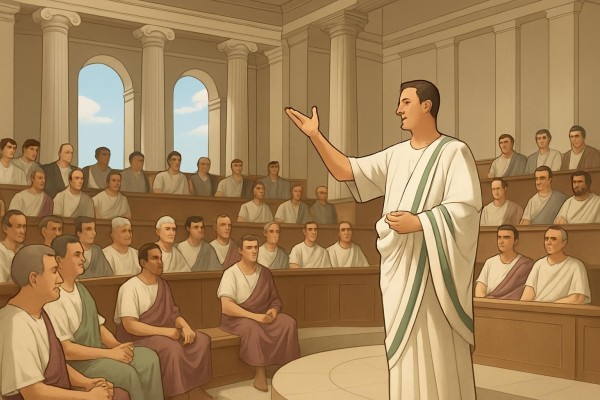
Marcus Terentius Varro (116–27 BCE) wrote across genres: from rural economy and etymology to encyclopedic surveys of religion and antiquities. Yet when we attempt to read his commentary on public institutions, one theme becomes clear: Varro revered the accumulated customs and practical knowledge embedded in Rome's governing mechanisms. He regarded the Senate as a repository of auctoritas — an intangible reserve of legitimacy and memory — while viewing the various popular assemblies as the venue through which the city's citizens expressed legal will and conferred magistracies. In Varro's account the two worked in uneasy partnership; he was attentive to their limits and frictions and alert to the vulnerabilities that eroded republican restraint.
Senate: Tradition, Expertise, and Auctoritas
For Varro the Senate was not merely a deliberative chamber; it was the cumulative expression of mos maiorum — the ancestral habits that guided Roman political life. He emphasized the Senate's role in foreign policy, fiscal oversight, and the custodianship of religious propriety. Auctoritas, in Varro's vocabulary, could not be manufactured by rhetoric alone; it accrued through continuous practice, the adjudication of precedent, and the retention of institutional memory. In practice this meant that senators — whether distinguished by past magistracies or by their learned conservatism — served as the stabilizing element when the passions of assemblies ran high.
Varro recorded how the Senate's influence was both formal and informal. On paper, the Senate issued senatus consulta, advisory decrees that lacked the force of law without a vote of the people; in reality, a Senate united by consensus could direct magistrates and shape legislation indirectly. Varro's descriptive approach often reads like a handbook: lists of procedural norms, the proper order of speeches, and even the expected etiquette of seating — because, for him, ritual and form underpinned substantive authority.
Assemblies: Expression of the Populus, Source of Legitimacy
The Roman people — the populus — manifested its sovereign capacities through diverse assemblies. Varro chronicled distinctions that mattered: the centuries of the Comitia Centuriata, where wealth and military service structured voting; the tribal organization of the Comitia Tributa; and the Concilium Plebis, where plebeian interests were most pronounced. He noted that assemblies were the ultimate forum for electing magistrates endowed with imperium and for passing statutes that created binding law. Yet he was also practical: assemblies were susceptible to manipulation by charismatic individuals, bribery, and disorder. Hence, the forms that governed assembly processes — the auspices, the presiding magistrate's pronouncements, the lex sacramenta that guided ballot procedures — were not mere ceremony but bulwarks against caprice.
Varro particularly attended to the procedures that secured lawful consent. A man steeped in antiquarian learning, he catalogued the rituals that preceded votes: auguries, lustrations, and the reading of religious texts. These rituals had a double purpose: they tied civic decisions to the religious cosmos and they provided recognized pauses where magistrates could reflect and where opponents might contest hasty action. To Varro, then, the legitimacy of assemblies depended on more than majorities; it depended on processes that reconciled the people's will with the city's moral and ritual order.
The Interplay: Magistrates, Senatorial Counsel, and Popular Ratification
Political authority in the late Republic moved through three conduits: magistrates wielding potestas and imperium, the Senate advising and shaping policy, and the assemblies validating or rejecting measures. Varro's writings — though scattered and fragmentary on this topic — present a model of reciprocal limits. Magistrates required the Senate's counsel to navigate foreign affairs and provincial administration; the Senate relied on assemblies to confer legitimacy to major acts; and the assemblies required clear procedural frameworks to avoid being reduced to the plaything of popular agitators or demagogues.
He was skeptical of shortcuts: the bypassing of deliberative stages, especially when magistrates sought immediate personal advantage, provoked Varro's disapproval. His prescriptions inclined toward tempering exceptional personal charisma with institutional constraints. Varro admired those statesmen who respected form — who, even when daring, kept one foot anchored in precedent.
Varro's Historicizing Method
What makes Varro valuable to modern readers is less a partisan program than his method: he placed institutions inside longue durée narratives. Varro traced customs to their origins, surveyed their transformations, and catalogued the legal texts and religious formulas that gave them content. This antiquarian impulse served an implicit political purpose — preserving what he judged prudent from the winds of improvisation. In doing so, Varro offered future generations a careful inventory of how institutions were meant to operate, and why certain practices mattered beyond mere habit.
He also engaged in comparative observation, contrasting Roman practice with that of other peoples when instructive. This broadened perspective allowed Varro to argue that Rome's mixture of senate-led deliberation and popular ratification created a durable polity — but only if its participants maintained a culture of restraint and respect for inherited norms.
Practical Consequences of Institutional Decay
Varro's contemporary milieu witnessed strains: factional confrontations, ambitious generals, and populist legislation. He warned — implicitly and at times explicitly — that when institutions lost their ritual checks or when senatorial counsel became mere posturing, the Republic's equilibrium collapsed. Assemblies turned volatile when procedural safeguards were ignored; senators lost credibility when they pursued narrow factional advantage. Varro lamented the degradation of civic virtue in conjunction with procedural laxity, believing that the two were mutually reinforcing.
His remedy was not a technocratic overhaul but a revival of habits: diligent recording, conservative prudence, and an insistence that ceremonies serving legal ends remain intact. In short, he sought to re-embed law within ritual and memory.
Legacy and Modern Readings
Modern scholars often turn to Varro for fragments of institutional history that other sources omit. His catalogues and digressions furnish procedural details — the precise sequencing of votes, the role of auspices before elections, the formal categories of law — that help reconstruct how the Roman constitutional system functioned in practice. Interpreters diverge on whether Varro's conservatism was merely antiquarian nostalgia or a reasoned argument for institutional resilience. Either way, his writings remind us of the subtle engineering embedded in political culture: rituals, calendars, and offices operate like safety valves; when they are neglected, unintended consequences follow.
For students of governance, Varro's perspective underscores a lesson that resonates today: systems depend on informal norms as much as formal rules. The Senate's power derived not just from statutes but from a shared sense among elites that certain lines should not be crossed. Assemblies derived force from the people's voice but required frameworks that made that voice legible and durable. Varro invites readers to see institutions as living practices rather than inert scaffolding.
Concluding Reflections
In Varro's mosaic of observation and prescription, the Roman Senate and the popular assemblies are complementary devices: one stores experience, the other commands endorsement. When each plays its role and respects the other's limits, the polity retains a dynamic of deliberation plus ratification. But when one eclipses the other, balance tilts toward domination — whether by a faction, an ambitious magistrate, or a momentary surge of popular fervor. Reading Varro carefully prompts appreciation for process, for the often unnoticed rituals that keep politics legible, and for the patient work of civic maintenance that undergirds any durable constitution.
이제 요약을 한국어로 제공합니다. 마르쿠스 테렌티우스 바로는 로마의 제도들을 오래된 관습과 의례의 관점에서 바라본 학자였습니다. 그는 원로원의 권위(auctoritas)를 전통과 전문성의 저장소로 보았고, 인민회의는 시민의 의사를 실천적으로 표현하는 장이라 여겼습니다. 바로는 제도적 절차와 종교적 의례가 단순한 형식이 아니라 정치적 정당성과 안정성을 지탱하는 핵심 장치라고 보았습니다. 따라서 제도 간 균형이 깨지고 의례적·절차적 장치가 약화될 때 공화정의 균형은 쉽게 무너지고, 개인적 야망이나 파벌이 권력을 장악하게 된다고 경고했습니다. 그는 해법으로 제도와 관습을 보존하고, 시민적 덕목과 절차적 엄수를 회복할 것을 촉구했습니다.
Tags:
댓글목록2
배지현님의 댓글
신시호님의 댓글의 댓글