When Republics Fray: Five Figures Who Stretched Rome's Rules

 운영자
운영자
본문
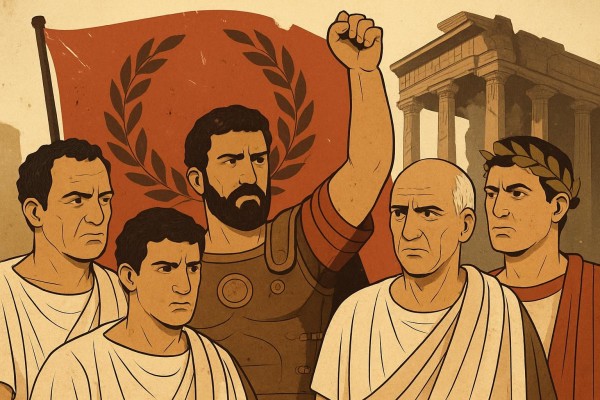
The Roman Republic did not collapse in a single day. Instead, its institutions were strained by politics, armies, and ideas—often embodied in specific, magnetic individuals. This piece follows five such figures whose choices and conflicts helped bend Rome's unwritten rules: the brothers who opened the age of popular reform, a military innovator who remade recruitment, a commander who marched on the city, and a Stoic senator who resisted what he saw as tyranny.
Setting the scene: a republic under pressure
From roughly 134 to 44 BCE, Rome experienced a series of political stresses—land dispossession, growing inequalities, disputes over citizenship, and the rise of arms as a political tool—that historians often group under the phrase the crisis of the Roman Republic. Scholars who reassess that period emphasize both structural change and the role of individual actors in accelerating breakdowns of norms. For a concise overview of the period and its debates, see the survey of the crisis.
Political norms can survive stress—but when leaders weaponize assemblies, armies, and violence, institutions become fragile.
Tiberius Gracchus: the tribune who changed what a tribune could do
As tribune in 133 BCE, Tiberius Sempronius Gracchus promoted large-scale agrarian redistribution aimed at restoring smallholder soldiers to Italy’s fields. His tactics—bypassing some senatorial protocols and seeking direct endorsement from the popular assemblies—set a political precedent that made later maneuvers by reformers and demagogues easier. Read a compact biography of his life and the ripple effects of his death for more detail.
Short pause: reforms that break old rules often produce a counter-reaction as powerful as the reform itself.
Gaius Gracchus: expansion, law, and unintended consequences
A decade later, Gaius Sempronius Gracchus took his brother’s project further—proposing judicial, military, and citizenship reforms that aimed to broaden support and bind Italy more tightly to Rome. His efforts to restructure provincial assignments and to involve the equestrian order in juries illustrate how legislative innovation can alter power networks, sometimes creating new elites rather than dissolving old ones. For a clear survey of Gaius’s program and its political fallout, consult a modern reference.
Quick takeaway: reformers often solve one problem and create another—legislative engineering reshaped alliances, and those new coalitions could be volatile.
Gaius Marius: armies, veterans, and a new political base
Gaius Marius changed recruitment by enlisting volunteers from the landless masses, which increased Rome’s military capacity but also forged a personal loyalty between soldiers and their generals. That innovation helped win wars—most visibly against migratory tribes in the north—but it also shifted political leverage away from the old property-based voting order and toward commanders who could mobilize veteran votes or muscle.
A short thought: when soldiers look to a leader for retirement and land, politics and army become tangled.
Sulla: the precedent that broke a taboo
Lucius Cornelius Sulla’s unprecedented march on Rome (and later return to seize power) demonstrated that a victorious commander could use force to change government, not only to defend it. His dictatorship and the proscriptions that accompanied it produced legal and extra-legal purges that reshaped elite politics—and crucially, they normalized military intervention in Roman civic life. For a focused account of Sulla’s career and constitutional measures, see the biography and analysis.
Once an army crosses an internal political line, restoring the old rules becomes much harder.
Cato the Younger: principle, obstruction, and the cost of purity
Marcus Porcius Cato, known later as Cato of Utica, embodied a strict republican ideal and used obstruction as a political tool against men he saw as threatening liberty—above all Julius Caesar. Cato’s steadfast resistance made him a moral exemplar for some and a hardliner for others; scholars argue his strategy helped polarize elites and contributed to the chain of events that culminated in civil war.
Short question to the reader: is principled obstruction a defense of institutions or a spark for their undoing?
Two lenses on the same story
One way to read these lives is institutional: reforms, military innovations, and norm-breaking acts eroded a consensus-based order. Another way is cultural: shifting ideas about citizenship, honor, and power made certain choices rational—even urgent—for men raised in that political culture. Recent scholarship argues we should see multiple, overlapping republics across time rather than a single, continuous institution collapsing at once.
Caution: celebrating strongmen or "restoration" narratives risks overlooking long-term adaptations and pressures that produced political breakdowns. Treat heroic biographies and structural causes as complementary, not exclusive.
What modern readers can take away
These five figures show how individual agency—when coupled with institutional weakness—can redirect history. Small procedural innovations, when repeated or weaponized, accumulate into systemic change. If you’re curious to dig deeper, the biographies and thematic studies linked in this article provide accessible entry points and more detailed bibliographies.
In short: institutions matter—but so do the choices of those who operate them.
Want a reading suggestion? Mike Duncan’s accessible narrative offers a lively synthesis of the decades that set the stage for Rome’s great transformation.
Final reflection: which of these tensions—economic inequality, military loyalty, or political norms—do you think is the most dangerous to republics today? It's worth asking because ancient patterns often echo in modern politics.
댓글목록0