Mechanics of Power: How the Roman Senate and Popular Assemblies Worked…

 운영자
운영자
본문
Why institutions mattered more than rhetoric
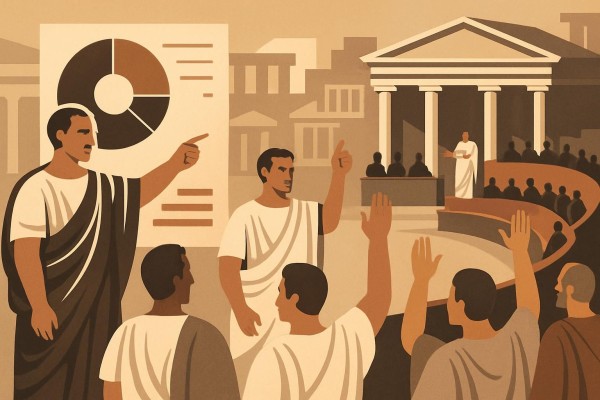
When we talk about the Roman Republic, it's tempting to picture dramatic debates by torchlight or a single orator swaying the crowd. The reality was more bureaucratic and, in its own way, more deliberate: a set of overlapping institutions — the Senate, several popular assemblies, and a cluster of magistracies — that together produced decisions. The Senate did not legislate in the same technical sense as the assemblies, but its weight of experience and control of finances made its advice decisive in many matters.
For a concise orientation, the Encyclopaedia Britannica provides a clear summary of the Senate's advisory primacy and its practical authority during the Republic.
The assemblies: four different machines of decision
Rome’s "people" were not a single body acting uniformly. They assembled in different comitia or concilia depending on the issue: the military-flavored Comitia Centuriata, the geographically ordered Comitia Tributa, the plebeian-only Concilium Plebis, and the older, largely ceremonial Comitia Curiata. Each had distinct procedures, qualifications, and venues.
The classic overview of these assemblies, their division by centuries or tribes, and the way votes were counted by unit rather than by head can be read in the Britannica entry on the comitia.
Quick checklist: Who decided what?
- Comitia Centuriata — war, high magistrates (consuls, praetors), capital jurisdiction and census-related rights.
- Comitia Tributa — civilian legislation, lower magistrates, and many trials.
- Concilium Plebis — plebeian legislation that, after Lex Hortensia, bound all Romans.
Counting by unit: centuries and tribes as political levers
The technical detail that shaped outcomes was not simple majority-by-person, but majority-by-unit. In the Comitia Centuriata citizens were grouped into centuries largely by wealth and military role; voting proceeded class by class, from the wealthiest down. That ordering often ensured that the economic elite could decide contests before poorer centuries were even called. This architecture mattered more than speeches on the Rostra: institutional order determined which votes were decisive.
For the institutional mechanics and their political consequences, see the focused entry on the centuriate assembly.
Institutions shape incentives; the Roman assemblies show how rules can hard-wire advantage.
Space and ritual: Comitium, Curia, and the performance of politics
Physical layout reinforced procedure. The open Comitium was the public stage for assemblies; adjacent lay the Rostra for orators and the Curia where senators deliberated. Over time, changes in buildings — such as Caesar’s remodelling of the Curia and the Comitium — reflected shifts in political balance and the self-promotion of elite figures. Archaeology and historical overviews of the Forum highlight how these spaces were both symbolic and functional.
Note: institutional change is often architectural — the Curia’s location and size mattered for who could claim legitimacy.
Tribunes, vetoes, and the legalization of plebeian power
The tribunes of the plebs were unique because their sacrosanct status and veto power could halt magistrates and protect citizens. Over the centuries the plebeian institutions moved from custom to law: critical milestones — for example the transfer of certain elections and the eventual force of plebiscites after reforms like the Lex Hortensia — changed how popular power translated into binding law.
A readable synthesis of the tribunate’s standing and the legislative evolution is available in studies of Roman political institutions and in general reference treatments.
Interaction, not isolation: how Senate and assemblies negotiated outcomes
The Senate often framed questions, controlled the purse strings, and advised magistrates; magistrates then convened assemblies to give the law formal force. Sometimes the Senate’s advice was implemented directly, sometimes submitted to the people. This back-and-forth meant that neither body could be read in isolation: the Republic’s governance was a choreography of proposal, ritual, and vote.
For a long-form treatment of Senate practice across the Republic, Jona Lendering’s account traces the institution’s shifting authority across centuries.
Why this matters for modern readers
Two reasons. First, the Roman example shows that the shape of rules and physical spaces matters for democratic practice: who counts first, who speaks from the stage, and who commands resources. Second, many modern debates about representative design — districting, weighted voting, the sequencing of decision steps — have practical analogues in the Republic’s century/tribe mechanics. It’s less a lesson in imitation and more a prompt to examine how rules structure real political advantage.
The Romans built a durable system because they matched procedural detail to social structure — and then watched what the rules produced.
Further reading and primary snapshots
If you want succinct reference entries and reliable summaries, start with the Encyclopaedia Britannica articles on the Senate, the Comitia Centuriata, and the Comitia Tributa. For spatial and archaeological perspectives, consult the Forum and Comitium overview at Britannica.
For a historian’s narrative that connects institutional practice to political outcomes, Jona Lendering’s synthesis on the Senate offers useful chronological nuance.
Takeaway
The Roman Republic’s politics were procedural: vote units, physical stages, and legally framed offices did as much to shape power as the orators who spoke there. Understanding the Senate and assemblies as interacting institutions — not as abstract principles of “democracy” or “oligarchy” alone — gives a more practical lens on how decisions were actually made.
Want to dig deeper? Start with the linked Britannica and Livius pieces above, then read a focused monograph on Roman voting assemblies for technical treatments of centuries and tribes.
댓글목록0