Judea in the Roman Republic

 운영자
운영자
본문
Judea in the Roman Republic
A vivid, elegant exploration of the politics, society, and daily life in Judea as Rome's influence grew during the late Republic.
In the final decades of the Roman Republic, the land known to many as Judea stood at a crossroads of tradition and transformation. This region—anchored by Jerusalem's temple and animated by the rhythms of synagogue and marketplace—found itself increasingly entangled in the power politics of Mediterranean hegemony. From the perspective of Roman generals and senators, Judea was both a strategic outpost and a prize that offered prestige, local resources, and the potential to reshape eastern politics. For its inhabitants, it was a locale where Hellenistic, Persian, and native Jewish currents met, clashed, and blended.
The story of Judea under the Republic is the story of negotiation — between kings and priests, between local autonomy and imperial ambition, and between ancient rites and the new realities imposed by Rome.
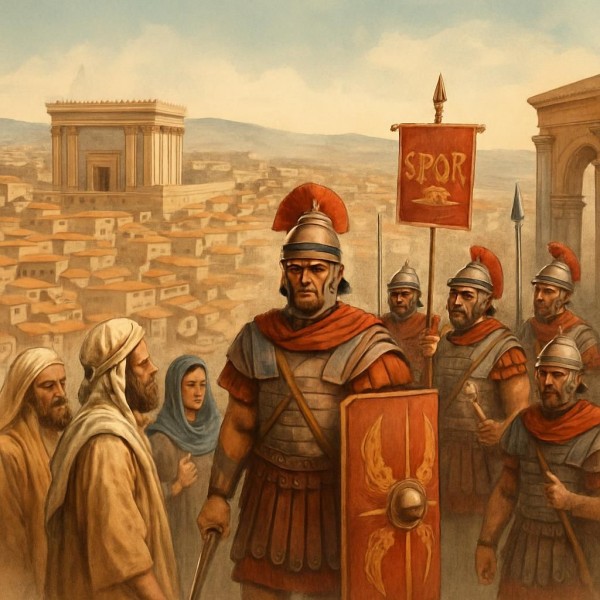
Political Context: From Hasmoneans to Roman Clients
In the centuries before Rome's direct involvement, Judea had been shaped by the Hasmonean dynasty, a polity born from revolt and sustained through a combination of priestly authority and dynastic claims. By the 1st century BCE internal feuds among Hasmonean princes and the centrifugal pull of Hellenistic culture weakened centralized authority. When Roman commanders advanced eastward, there was a window for intervention. In 63 BCE, the famous general who reshaped much of the eastern Mediterranean intervened in Judea's dynastic strife, marking an important turning point. After this campaign, Judea ceased to be an entirely independent kingdom and became instead a client territory whose rulers often depended on Roman approval.
The result was an uneasy hybrid: local institutions continued to operate, but they now functioned under the shadow of a distant power whose interests could be immediate and decisive.
Roman Strategy and Local Rulers
Rome's approach to the eastern provinces during the Republic was pragmatic. Rather than graft direct provincial rule everywhere, Roman statesmen sometimes preferred to support local clients who could maintain order at lower administrative cost. In Judea, key figures—some with priestly standing, some with aristocratic pretensions—were elevated or confirmed by Roman authority when it suited Roman geopolitical goals. This client model allowed Rome to project influence without deploying a full provincial bureaucracy, but it also introduced a new set of tensions: local rivalries could be magnified by Roman favoritism, and external interventions could become periodic flashpoints.
Notable consequences included a shifting balance between religious and secular power in Jerusalem, intermittent violence, and the continuous recalibration of loyalty among elites who sought Rome's favor while retaining legitimacy before their own people.
Administration, Law, and Roman Oversight
After the Republic's interventions, Judea's internal administration did not instantly mirror Roman provincial systems. Instead, local legal traditions—rooted in Jewish law, custom, and the institutions of the Temple—remained influential. Yet Roman governance affected the practical operation of justice and taxation. The Romans imposed fiscal obligations and required local leaders to ensure stability along routes of strategic or commercial importance. Roman magistrates and military officers occasionally moved through the region, and Roman coinage circulated alongside local currencies, serving as reminders of the wider imperial network that now encompassed Judea.
In civic life this often produced a plural legal reality: Roman imperatives and exceptions could coexist with synagogue courts and temple-led adjudication, creating spaces of negotiation that defined day-to-day governance.
Economy, Trade, and Urban Life
Economically Judea occupied routes that linked inland agricultural districts with coastal ports. The Roman presence expanded markets for local produce—olive oil, wine, dried fruits—and connected Judea to Mediterranean trade networks. Cities and towns displayed a spectrum of cultural influence: some embraced Hellenistic architecture and institutions; others preserved distinctly Jewish municipal patterns. Markets, synagogues, and the Temple precinct were centers of exchange not only in goods but in ideas.
Ordinary life could be cosmopolitan in port towns, and more conservative in rural areas where traditions anchored daily practice.
Religion, Identity, and Cultural Tensions
Religion anchored Jewish identity in ways that often complicated Roman relations. The Temple in Jerusalem remained the focal point of religious life, and priestly families played pivotal political roles. Meanwhile, Hellenistic culture—language, urban planning, and philosophy—left its imprint, especially among urban elites. This created social gradients: some elites adopted Hellenic fashions and patrons, while many did not. Tensions arising from these cultural layers could be amplified by Roman interventions that appeared to support one faction over another or that inadvertently misread local religious sensitivities.
In such an environment, rituals, dietary laws, and Sabbath observance were not simply private matters; they became markers with political resonance, informing communal cohesion in the face of external domination.
Conflict, Resistance, and Accommodation
The transition from independence to clientage was not a smooth or linear process. Periodic uprisings, palace coups, and appeals to neighboring powers such as the Parthians punctuated the late Republican period. Local leaders sometimes sought external allies; at other times communities pursued quiet accommodation to protect worship and local autonomy under the new realities. Roman responses varied: punitive displays of force happened alongside strategic concessions to local elites who promised stability.
The result was a pattern of pragmatic coexistence punctuated by crisis—an uneasy balance that would continue into the early years of Roman imperial consolidation.
Culture, Scholarship, and Exchange
Judea's intellectual and religious life remained vibrant. Synagogues served as hubs for literacy and interpretation of sacred texts. Hellenistic education—Greek language and philosophy—coexisted with scriptural study, producing diverse intellectual currents. Travelers, pilgrims, and merchants carried ideas across regional networks, and the interplay of languages—Hebrew, Aramaic, and Greek—reflected a layered cultural identity.
Artistic expression, funerary practices, and architectural choices also reveal a society negotiating between continuity and change, producing artifacts that attest to adaptability rather than uniform assimilation.
Legacy: How the Republican Era Shaped Later Developments
The entanglement with Roman politics during the Republic set patterns that had long-term consequences. Client rulership, the intermingling of Roman and local law, and the social fissures that opened in this period helped shape the forms of governance and resistance that characterized Judea in subsequent decades. Even after power transitioned formally to imperial institutions, the choices made in the late Republican era—alliances with certain factions, the accommodation of Roman fiscal demands, and the persistence of priestly influence—continued to influence political trajectories.
Thus, understanding Judea during the Republic is essential to understanding the later transformations that would affect the wider region.
Quick takeaways
- Local autonomy persisted but under increasing Roman influence.
- Client rulers became the prism through which Rome managed Judea's affairs.
- Cultural plurality—Hebrew, Aramaic, Greek—defined daily life and elites alike.
- Religious institutions remained central to identity and politics.
Concluding reflections
The story of Judea in the age when Rome was a republic is not a simple tale of conquest followed by assimilation. Rather, it is a nuanced narrative of exchange and friction: Roman political calculation met an ancient religious culture; commerce and coins circulated alongside laws older than the new masters. By studying this interlude, we gain a richer appreciation for how imperial systems use local intermediaries, how cultural identities adapt, and how communities negotiate dignity and survival under the watchful eye of distant authority. These themes resonate beyond antiquity: they are lessons about power, identity, and the art of living under circumstances shaped by larger states.
If you enjoyed this deep dive, consider exploring primary sources from the era, archaeological reports from Judean sites, and modern syntheses that probe the subtle interplay between Rome and its eastern clients.
마지막으로, 이 글에서 다룬 핵심 내용을 간단히 요약하면 다음과 같습니다. 고대 로마 공화정 시기의 유대아는 독립의 상실과 동시에 복잡한 적응의 시기를 맞이했습니다. 한편으로는 성전과 종교 기관이 공동체 정체성을 유지하게 했고, 다른 한편으로는 로마의 정치적 계산과 동지(동맹) 시스템이 지역 권력 구조를 재편했습니다. 경제적 교류와 문화적 혼합은 일상생활에 깊은 영향을 미쳤고, 지역 엘리트들은 헬레니즘적 요소와 전통적 유대 정체성 사이에서 균형을 모색했습니다. 이러한 과정들이 이후 제정 시대의 전개와 갈등 양상에 중요한 밑그림을 남겼습니다.
댓글목록2
박준우님의 댓글
문민우님의 댓글