Listening to Power: Sound, Stagecraft, and the Politics of Roman Repub…

 운영자
운영자
본문
Introduction — a different lens on Roman politics
When we say "assembly" in the context of the Roman Republic most readers picture ballots, factions, and the magistrates’ speeches. But politics is not only written law or voting tallies; it is also practice: how people hear, see, and move in public. This article examines how built stages, temporary platforms and the city’s soundscape participated in political persuasion—drawing on recent archaeological discoveries and modern acoustic research to reframe popular gatherings as performative events rather than purely procedural moments.
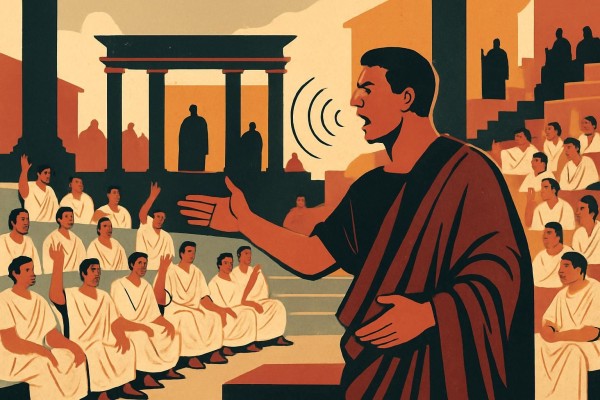
I will weave three strands: material traces from recent excavations, experimental and theoretical acoustic work on ancient spaces, and the practical uses of temporary staging (rostra, tribunalia and ad hoc platforms). Along the way we’ll be guided by new field reports and conference syntheses that illuminate how Republican-era urban fabrics shaped public speech. See the recent discussion of Regia research for fresh local context and excavation perspectives. (Regia seminar overview).
Listening changed who mattered: skillful oration required a stage, and a stage required urban choices.
New material clues: what recent digs are telling us
Excavations across Italy and in provincial fora have supplied physical detail—platform remains, statue pedestals and urban refurbishments—that help us imagine how assemblies were staged. For instance, recent fieldwork has produced detailed studies of fora in smaller towns where display programs and statue placements mimic the capital’s approaches, suggesting deliberate civic choreography of sight and sound. Read about new discoveries in Valeria and how its forum’s displays echo Roman models. (Valeria forum findings).
Closer to Rome, recent reports of Republican-era domestic architecture and public features uncovered between the Palatine and the Forum underscore how political actors were spatially embedded in residential and ritual landscapes; such proximity shaped where magistrates could draw supporters and where crowds could gather. See the excavation summary on a Republican domus discovery near the Forum. (Republican domus discovery).
Acoustics as evidence — listening with science
Over the last decade, acoustic archaeology and experimental work have moved from theatre-focused studies to asking how speech propagated across irregular urban terrains. While amphitheatres and Greek theatres were designed for projection, Republican assemblies often took place in hybrid spaces—part open square, part built front with monuments and porticoes—which altered reverberation and intelligibility. Several recent publications synthesize acoustic methods applicable to ancient civic spaces; these help us test hypotheses about which platform placements favored specific audiences. See a recent special issue on ancient acoustics for methodological framing. (Acoustics special issue).
The takeaway is simple: sound travels unevenly in stone-built urban pockets. Officials who controlled platforms—magistrates, lictors, orators—could exploit architectural echoes and sightlines. That control shaped persuasive reach just as much as rhetorical skill.
Quick practical point: a raised rostra or a temporary tribunal built against a colonnade could increase intelligibility for a core crowd while muffling peripheral dissent—design as rhetorical amplifier.
Stages, audiences, and crowd management
The Roman Republic lacked modern PA systems; political communication was corporeal. Speakers relied on proximity, gesture, visual cues (statues, banners), and spatial choreography—where clients stood, where senators positioned themselves, and where voting tribes assembled. Temporary staging did more than elevate a voice: it curated the audience. Magistrates could funnel crowds into narrow approaches or widen a forum’s frontage depending on the political need.
This perspective helps explain why municipal elites invested in forum refurbishments that seem, at first glance, merely decorative: architectural frames were also political tools. Comparative excavation reports from provincial fora show conscious mimicry of Roman staging practices, suggesting a shared repertoire of political theatre across the republic and later provinces. Consult comparative work on southern Italian forum excavations for context. (South Italy archaeological reports).
Public space is a medium. The arrangement of stones and statues speaks long before words begin.
Reading inscriptions, pedestals and ephemeral evidence
Stone survives; wooden platforms do not. That asymmetry biases our sources. Yet pedestals, altars, and dedicatory inscriptions create a visual script that accompanied speakers. Recent cataloging of pedestal finds in smaller municipalities shows how honorific programs established preferred vantage points for civic rituals—these are the fixed poles around which ephemeral stages were erected. See the recent catalogue and discussion of statue pedestals from Valeria for an example of how display programs signal audience orientation and ceremonial choreography. (Valeria pedestals).
Inscriptions sometimes record the funding of temporary structures for games or assemblies; these administrative traces hint at logistical planning—a reminder that staging required resources, labour, and coordination, and therefore could be politicized.
A short case sketch: imagine an election day
Picture a morning in late-Republic Rome: a magistrate’s attendants clear a narrow approach, columns cast long shadows, and a scaffold faces a bank of statues. Clients gather close; the crowd fans outward. The speaker’s voice catches on the stone backdrop, carried to the core supporters and lost at the edges. A rival tries to make a counter-appeal from a different projection point; the result is cacophony and fragmentation. The architecture has just mediated the politics.
Tip for readers: when you visit ancient fora, walk the imagined sightlines. Platforms and pedestals still indicate designed focal points.
What this approach changes
Reading Republican assemblies through sound and staging complements institutional histories: it explains variation in outcomes that procedural accounts struggle with. It also opens new interdisciplinary work—combining archaeological stratigraphy, inscriptional study and acoustic modelling—to test how different spatial configurations favored particular political actors.
Scholars and practitioners convened recently to reassess central sites and their archaeological contexts; such dialogues are expanding our toolset for reading political performance in the material record. The Regia conference is one invitation to reconsider familiar ruins in light of renewed fieldwork. (Regia seminar).
Limitations and caution
We should be cautious not to overread the material: acoustic reconstructions are model-based and sensitive to assumptions about crowd density, clothing, and surface finish. Excavations are unevenly distributed geographically and chronologically. New finds—like domus and forum refurbishments—are informative but do not provide a full blueprint of everyday political life. For a careful methodological overview consult contemporary acoustic and excavation reviews. (acoustic methods review).
Conclusion — listening as method
If we take sound and stagecraft seriously, assemblies become theatrical events where urban form, temporary architecture and social choreography jointly shape political possibility. This does not replace institutional analysis; it enriches it, offering fresh hypotheses about persuasion, crowd control and civic visibility. Recent archaeological campaigns and acoustic research offer practical entry points to test those hypotheses—moment by moment, stone by stage.
Final thought: political power in the Roman Republic was heard as much as it was seen.
Further reading and selected excavations referenced above: Republican domus discovery, Valeria forum report, South Italian forum excavations, and a methodological primer on soundscapes (acoustics special issue).
Warning: reconstructive claims about audibility are probabilistic. Treat acoustic models and spot excavations as tools for hypothesis-building, not definitive narratives.
I hope this prompts you to listen differently when you read about assemblies or stand among ruins: the stones still remember the shape of a voice.
댓글목록0