Polybius: Senate vs Assemblies

 운영자
운영자
본문
Polybius: Senate vs Assemblies
A deep reading of Polybius' perspective on the constitution and the political balance that made the Roman state formidable.
Polybius of Megalopolis, the Hellenistic historian whose Histories sought to explain Rome's meteoric rise, remains one of the most precise observers of Republican governmental mechanics. In his accounts he offers not merely a narrative of events but an analytic framework: a diagnosis of institutions, a theory of mixed government, and an argument that the equilibrium of Rome's Senate, the people, and magistracies produced durability and success. His study is as much political theory as it is historiography — an interweaving of practical description and normative insight.
A long-term view: institutions, incentives, and habits that shape outcomes.
For Polybius, the Roman constitution is a classic instance of a mixed constitution — an ordered blend of monarchy, aristocracy, and democracy. He locates these elements in the office of the consuls (executive command), the Senate (aristocratic deliberation), and the citizen assemblies (popular sovereign acts). But Polybius does not stop at labels; he probes the dynamics among these parts. The question he seeks to answer is less theoretical than empirical: how did these organs interact to produce coherent policy, military efficiency, and a resilient polity in the face of external and internal shocks?
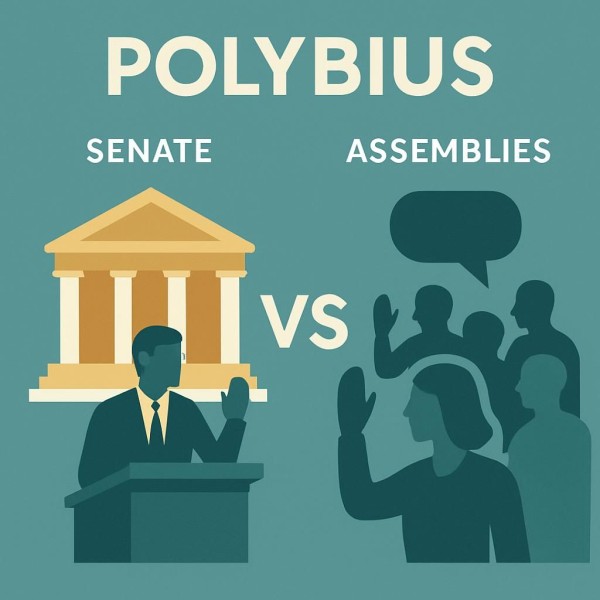
The Senate: Prudence, Continuity, and Experience
The Roman Senate, in Polybius' account, functions as the repository of collective memory and long-term strategy. Its advantages are several and interlocking. First, senators were typically older, with experience in multiple magistracies and military commands; they brought practical knowledge to deliberation. Second, the Senate's deliberative character enabled deliberation free from the immediacies that often sway crowd decisions. Third, its role in finance and foreign policy created institutional continuity: budgets, treaties, and administrative routines were stabilized through senatorial oversight.
Senatorial authority is not mere oligarchy; in Polybius' view it is a moderating force that tempers the excesses of both the consul and the crowd.
Polybius is careful to acknowledge defects: the Senate can be self-serving, slow, and prone to faction. Yet these defects are checked by the centrifugal forces of magistrates and the assemblies. Importantly, Polybius sees an institutional architecture where each element imposes limits on others, essentially a system of mutual constraints that prevents any single organ from monopolizing power.
Popular Assemblies: Legitimacy, Mobilization, and Risk
The assemblies embody the democratic element. In Polybius’ framework, they play crucial roles: electing magistrates, passing laws, and ratifying war and peace. This popular sovereign power provides legitimacy — a necessary counterweight to elite concentration. Citizens, when organized, can overturn senatorial decisions, and the very possibility of popular intervention constrains aristocratic overreach.
But Polybius warns that assemblies are volatile. Fierce passions, demagoguery, and short-term incentives can produce destabilizing choices. His portrayal of the crowd is not romanticized; it is realist. Popular power brings energy and broad consent, but also the risk of impulsive decisions that undermine strategic coherence.
The critical insight for Polybius is that assemblies and the Senate do not operate in isolation: the assemblies' democratic legitimacy restrains senatorial calcification, while senatorial expertise and continuity prevent populist caprice from wrecking governance. Magistrates, particularly consuls and praetors, mediate between these poles.
Magistrates and the Executive Tension
The magistracies — especially the consuls — are Polybius’ exemplar of the monarchical element: they wield command, make swift decisions, and direct armies. The consuls’ temporary and limited tenure is crucial: short terms and collegiality (two consuls) create rapid action without permanent domination. Polybius admired how offices combined decisive leadership with accountability: magistrates could be held responsible after their term, and the shadow of accountability disciplines command decisions.
Executive fire tempered by institutional chains.
Importantly, magistrates answer both to the Senate and to the people, a dual accountability that aligns short-term action with long-term policy. Polybius emphasizes this multipart accountability as essential to sustain military success: generals pursue ambitious campaigns knowing they must later explain their conduct to senatorial peers and to the electorate.
Checks, Balances, and Institutional Incentives
What makes Polybius’ analysis enduring is his focus on incentives and institutional feedback loops. He is less interested in abstract justice than in durability: which arrangements produce a polity capable of expansion without collapse? In his diagnosis, mutual checks — vetoes, appeal mechanisms, and the diffusion of power — create a stable equilibrium. The Senate’s advisory weight, the assemblies’ sovereign powers, and the magistrates’ executive dynamism produce a balance in which individual ambition is harnessed to collective ends.
A recurring theme in Polybius is moderation. Elite ambition pushed Rome to act; popular energy ensured consent; magistracies turned both into action. Moderation is institutionalized through overlapping authorities: a treaty might be negotiated by consuls, guided by senatorial counsel, and ratified by the people. Failure in any link can imperil the policy chain, which is why Polybius pays close attention to procedural norms, rituals, and the reputational capital of political actors.
Tensions and Pathologies
Even as Polybius celebrates balance, he recognizes pathologies. Corruption, factionalism, and the concentration of wealth threaten equilibrium. When the Senate becomes captured by particular families, when magistrates pursue private gain, or when the crowds are stirred by demagogues, the system tilts. Polybius warns that the Roman framework is not self-correcting without active cultural norms: honor, shame, public virtue, and the prestige of ancestral values are supplementary mechanisms that sustain the constitutional balance.
Polybius is not blind to contingency: war, charismatic leaders, and economic pressures can shift incentives and break institutional safeguards.
His broader political lesson resonates: institutions matter, but so do the informal norms and the civic character of elites. The structural design can be undermined without the cultural substrate that supports restraint and public service.
Comparative Observations and Modern Relevance
Readers of Polybius often draw analogies to later constitutional designs. His advocacy for separation of powers, checks and balances, and mixed regimes anticipates debates that would reappear in Renaissance and Enlightenment thought. But Polybius is not a template for modern institutions; he is an analyst of mechanisms. The specificity of Roman offices, patronage networks, military imperatives, and social hierarchies shaped how checks functioned. Transposing his lessons requires attention to context: modern democracies face different vectors — mass media, bureaucratic states, globalized markets — that alter incentive structures.
Still, the core insights hold value. Institutional interdependence, the interplay of local incentives and long-term constraints, and the role of civic norms in stabilizing constitutional bargains are timeless points that scholars and practitioners can study fruitfully. Polybius encourages a pragmatic stance: design institutions to channel ambition positively; create overlapping authorities to prevent capture; cultivate norms that incentivize public-minded conduct.
Illustrative Examples from the Roman Experience
Polybius supplies concrete episodes to illustrate his points: senatorial debates over war financing, assemblies overturning elite proposals, and magistrates prosecuted after poor conduct. These episodes show how the mixed constitution was not an abstract machine but a living process. Consider the way senatorial advice shaped strategic deployment during prolonged campaigns, or how popular ratification could legitimize extraordinary measures. Polybius reads these practices as functional — often messy, but effective when norms held.
Another telling feature is the Roman practice of extending imperium and creating special commands under extraordinary circumstances. Polybius recognizes that such exceptions test constitutional stability; their repeated use can normalize exceptional power. Thus, while Romans could adapt, Polybius warns against the gradual accretion of exceptional prerogatives that, over time, may corrode institutional checks.
Concluding Reflections
Polybius offers a model of constitutional analysis grounded in observation and concern for longevity. His portrait of the Roman interplay between Senate and assemblies — mediated by magistrates — is a study in calibrated institutional design. The Senate provides prudence and memory; the assemblies provide legitimacy and dynamism; magistrates provide execution. The interplay restrains vice, coordinates action, and fosters resilience. Yet the system’s sustainability depends on informal virtues and robust civic practices that reinforce formal constraints.
Polybius does not offer utopia. He offers a method: study institutions, trace incentives, and build mechanisms that align private motives with the public good.
댓글목록0