Votes, Walls, and Laws: Campaigning, Ambitus, and Visual Politics in t…

 운영자
운영자
본문
Why assemblies mattered beyond the Curia
When we say "the assemblies" in the Roman Republic, it's easy to picture formal procedures and ballots. But the lived politics that brought men to those voting places — the canvassing, banquets, painted notices, and legal wrangling over corruption — is where votes were earned or bought. This piece traces how candidates shaped public opinion before and around assembly days, how law tried to regulate that contest, and what recent local finds tell us about everyday electioneering.
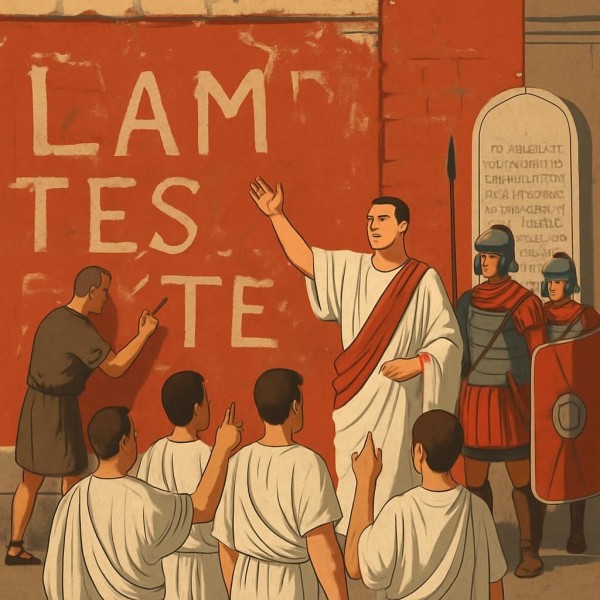
Material campaigning: the visible language of electioneering
Campaigning in the Republic was intensely visual and social. Candidates used painted notices (dipinti), scratched graffiti, coins, public banquets, and private hospitality to create an image and to remind voters of obligations. Archaeological work in cities such as Pompeii has repeatedly uncovered campaign dipinti and wall-slogans that functioned as local manifestos and endorsements, giving us direct evidence of how urban spaces hosted political conversation. See recent reports on new election notices unearthed in Pompeii for concrete examples of this practice. (Pompeii: election manifesto discovery)
Painted slogans on ordinary walls were not mere slogans; they were part of a grassroots media ecology that reached voters who might never see an elite oration.
Common campaign tools (a quick list)
- Dipinti and graffiti — public endorsements painted on façades and inside houses.
- Patronage displays — banquets, spectacles, and gifts that signaled generosity.
- Numismatic imagery — coin issues and statuary projecting status and continuity.
- Personal canvassing — visiting neighborhoods, municipia, and coloniae in person.
- Legal maneuvering — using prosecutions or laws to undercut rivals.
The list shows a mix of media, ritual, and legal strategies. Each item shaped the environment in which assemblies made decisions: they were signals as much as promises.
Ambitus: the legal response to aggressive canvassing
Roman legislators repeatedly tried to curb corrupt electioneering under the rubric ambitus — a flexible term that covered bribery, lavish largesse, and "going around" voters in improper ways. The legislative record is long: early statutes such as the Lex Baebia began the process, and later measures (for example the lex Tullia and the lex Pompeia) raised penalties and created political opportunities for rivals to prosecute one another. Modern studies emphasize that these laws were as much political tools as instruments of reform. (ambitus overview) (lex Pompeia de ambitu)
Note: ambitus was legally ambiguous. Scholars caution that prosecutions often reflected elite rivalry rather than clean anti-corruption impulses; laws regulated certain distributive acts while leaving traditional patron-client exchanges intact.
The secret ballot and its political consequences
From the mid-2nd century BC, a series of tabellariae leges introduced voting by secret ballot. The laws (beginning with the lex Gabinia in 139 BC and continued by later plebiscites) transformed how clientage and public pressure could influence results: in theory, secret voting freed many electors from direct coercion by powerful patrons; in practice, elites adapted their strategies and ambitus laws evolved in response. For those details, consult classic treatments of the tabellariae leges and the scholarship that traces their political effects. (tabellariae leges — historical account)
The secret ballot did not end buying votes; instead it shifted the balance between public displays of generosity and more subtle forms of influence, and it complicated the ability of patrons to monitor client behavior at the ballot box.
Local evidence matters: what Pompeii and graffiti teach us
Graffiti and painted notices in municipal towns are invaluable because they show campaigning outside Rome's elite circuits. Recent excavation reports from Pompeii document painted election posters and indoor graffiti connected to specific candidates and events; these finds reveal the ordinary mechanics of local mobilization — hosts who threw dinners, houses that served as meeting nodes, and walls that carried lists of endorsements. For accessible syntheses of these finds and their interpretive weight, see contemporary reporting and museum commentary. (Pompeii discovery report) (Smithsonian on Pompeii graffiti)
Local dipinti show that everyday spaces — bakeries, atria, taverns — doubled as nodes of persuasion long before electors lined up at Rome’s comitia.
Scholarly debates: intention, effect, and evidence
Historians disagree about the primary function of anti-ambitus legislation: was it principled reform or elite competition? Recent overviews and journal articles argue both points and stress complexity — the laws shaped behavior, but so too did changing social structures and new forms of media (from walls to coinage). For a thorough analysis of electoral bribery as a political institution and tactic, see leading treatments in the field. (electoral bribery — Journal of Roman Studies article)
Practical takeaways for reading assemblies differently
If we want to understand how assemblies decided outcomes, we must couple procedural texts with evidence about persuasion in the streets. Look for three converging strands in any case:
- The formal rule — which vote method and which law applied that year.
- Material persuasion — posters, coins, banquets, and graffiti circulating in the electorate.
- Legal enforcement — ambitus prosecutions and how elites used courts to shape competitions.
Combining these strands helps us explain continuity and change: the secret ballot altered incentives, but local campaigning and elite resource mobilization adapted — sometimes becoming subtler, sometimes more aggressive.
Quick reference: the secret ballot was introduced through a series of tabellariae leges beginning in 139 BC; ambitus laws from the 2nd century BC onward tried to police undue influence; local finds like Pompeian dipinti give us granular evidence of how campaigns operated on the ground.
Final note — reading the walls as sources
Assemblies in the Roman Republic were not hermetically sealed institutions. They were embedded in a media ecology of walls, meals, coins, and courts. To reconstruct how votes were won, we must take seriously the messy intersection of public procedure and private persuasion — and keep watching municipal archaeology, where the most human traces of campaigning often survive.
How might an election poster scratched on a Pompeian wall change the way you picture a Roman voting day?
Further reading and sources referenced in this piece: tabellariae leges and the history of the secret ballot (Penelope/Parker), the scholarly debate on ambitus and electoral bribery (Journal of Roman Studies), overviews of ambitus and specific laws (ambitus summary and lex Pompeia), plus recent archaeological reportage on Pompeian election notices (SeePompeii) and interpretive journalism on graffiti (Smithsonian).
If you’d like, I can assemble a printable one-page timeline of key laws and a gallery of representative dipinti and inscriptions (with image credits), or draft a short classroom exercise for reading election graffiti as primary sources.
댓글목록0