Didymus: Roman Senate & Assy.

 운영자
운영자
본문
Didymus: Roman Senate & Assy.
A cultured meditation on how a Greek scholar's philology and commentary culture interacted with the political life and institutions of the Roman Republic and its assemblies.
Framing the Conversation
In the rich cultural exchange between Greece and Rome, the role of learned commentators is often underappreciated. Didymus Chalcenterus — a name that resonates in the corridors of ancient philology — represents a body of scholarship that, although primarily textual and literary, intersected peripherally with the political life of the Roman Senate and the popular assemblies (often abbreviated here as Assy. for brevity). This essay explores that intersection: how scholarly methods, interpretive norms, and transmitted texts shaped rhetorical training, legal argumentation, and civic memory in republican Rome.
Who Was Didymus?
Though primarily an Alexandrian grammarian and commentator, Didymus became an emblem of exhaustively annotated scholarship. He compiled scholia, glosses, and critical notes on many canonical authors: poets, tragedians, and historians. The sheer magnitude of his output earned him the epithet "Chalcenterus" — the "bronze-gutted" or "with a molten sounding voice," a colorful reference to his prolific nature.
His methodology — careful collation of variant readings, cross-referencing parallel passages, and the rigorous pursuit of authorial intent — contributed to a cultural toolkit that numerous Roman intellectuals found productive for their own rhetorical and legal endeavors.
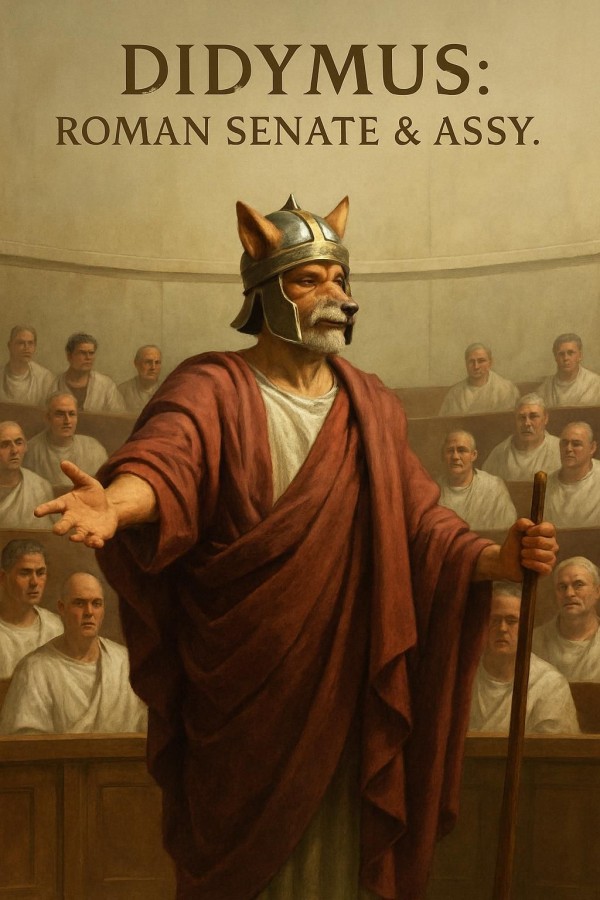
The Roman Political Stage: Senate and Assemblies
To appreciate any connection between Didymus and Roman political life, a brief orientation is useful. The Roman Senate functioned as a deliberative body of elite magistrates and former magistrates; the assemblies (comitia, concilium) were instruments of civic decision-making where laws could be passed and magistrates elected. Political rhetoric, memory of precedent, and mastery of precedent texts were crucial in both venues.
In such a culture, commentators and teachers who curated authoritative texts helped supply the building blocks of persuasive argument: scriptural references, historical exempla, and the moral weight of poets and chroniclers.
"A republic's law and rhetoric are made of words as much as statutes; those who preserve and explain the texts give legislators and orators their instruments."
Didymus' Philology as a Resource for Oratory
Roman orators trained in the Greek paideia drew extensively on Greek poetry and historiography to furnish their speeches with weighty quotations and apt analogies. Didymus — even if his works circulated primarily among learned Greeks — provided a reliable apparatus for finding, explaining, and authenticating such quotations. A rhetor who could summon an obscure line of Homer or clarify a disputed variant in a tragic passage gained a subtle advantage in the Senate or before a popular crowd.
More than ornamentation, these citations functioned as precedents. A senator invoking a storied episode from Greek epic to justify a political course of action relied on the intermediary labor of scholars who safeguarded textual stability.
Legal Language and Textual Criticism
Legal argumentation depends on authoritative reading. The Roman jurist’s craft — interpreting statutes, precedents, and ritual formulae — parallels the textual critic’s attention to variants. Though Didymus focused on literary texts rather than legal codices, the modus operandi is instructive: collating readings, weighing manuscript authority, and reconstructing probable original wording.
If Roman legal interpreters adapted philological techniques to stabilize legal language, then scholarly traditions like Didymus' provided an epistemic model for rigorous annotation and the prioritization of source-critical norms.
Education, Memory, and Civic Identity
Schools in Rome taught Greek literature as part of elite education. Such curricula transmitted not only texts but interpretive habits. Through scholia and commentaries, students learned to parse, to nuance, and to place passages in historical and ethical perspective. Those habits had political consequence: civic identity is shaped by the stories a polity repeats and the glosses that interpret them.
When senators allude to classical exempla, they are employing a common memory. Scholia acted like marginalia on that memory, clarifying the moral point or rescuing an episode from obscurity. Thus, Didymus' labors contributed indirectly to the matrix of civic knowledge that underpinned rhetorical appeals in both Senate debates and popular assemblies.
Speculative Encounters: Imagining Didymus in the Forum
Let us indulge a disciplined imagination. Picture a senator presenting a motion in the Comitium. He quotes a line attributed to a Greek poet to buttress his claim about civic virtue. An attendant literatus — schooled in philology — corrects the citation, offering an alternate reading preserved in a scholion. The correction changes the rhetorical valence of the reference, nudging the assembly's perception.
Events like this illustrate how dense networks of readers and teachers acted as backstage technicians of political persuasion. Whether or not Didymus himself ever lectured to Romans, his textual descendants functioned as soft power — shaping which words were available to politicians and how they would be read.
Reception and Transmission
The survival of many ancient authors owes something to the industriousness of scholars like Didymus. Manuscript transmission in late antiquity and the early medieval period reflexively depended on commentaries that guided copyists. By preserving and annotating canonical poets, Didymus and his peers indirectly shaped the textual resources available to Roman lawyers, historians, and orators in later centuries.
The transmission chain is crucial: an orator quoting Homer in republican Rome might be relying on an interpretive tradition that, generations later, a commentator like Didymus would systematize — or vice versa, depending on chronology. The lesson is that intellectual labor and political life share a lengthy, two-way street of influence.
Case Studies: Text, Law, and Rhetoric (Concise Examples)
- Quotational authority: How variant readings of a moralizing verse could alter a senator's moral appeal.
- Legal formulae and textual integrity: The philological habit of privileging the most coherent reading helps explain juristic preference for stable formulae.
- Schoolroom exegesis: Rhetorical training that relied on annotated texts produced more disciplined public speakers.
Limitations of the Argument
Caution is warranted. Direct documentary evidence linking Didymus personally to republican institutions is scarce. The essay rests on a plausible chain of cultural transmission and the well-attested Roman habit of borrowing Greek learning. Thus the relationship is best described as an indirect or structural influence rather than a record of meetings in the Curia or the Forum.
Why This Matters Today
Looking back at the interplay of scholarship and politics shows how intellectual labor undergirds civic discourse. Philology is sometimes imagined as an esoteric pursuit; yet its techniques — critical reading, attention to variant voices, and contextual reconstruction — remain vital tools for any polity that values textual continuity and persuasive practice.
In modern terms, Didymus' legacy invites us to reflect on the invisible scaffolding of expertise that supports public deliberation. Whether in law, journalism, or academic exegesis, the curatorial practices of specialists shape the resonance of public speech.
Conclusion
The story of Didymus and the Roman public sphere is not a tale of direct involvement but of enduring influence. Through the preservation of texts, commentary, and teaching, the philological tradition supplied Roman orators and jurists with a repertoire of authoritative language, exemplary narratives, and interpretive practices. The senatorial crest and the assembly's rostra were, in one sense, built out of words — and scholars like Didymus helped to keep those words intelligible and rhetorically potent.
Tags
요약 (한국어):
이 글은 그리스의 저서와 주석 전통이 어떻게 로마 공화정의 정치적 수사와 제도에 간접적으로 영향을 미쳤는지를 탐구합니다. 디디무스 찰켄테루스의 방대한 주석 활동은 고전 텍스트의 보존과 판독 규범을 확립하는 데 기여했고, 이러한 전통은 로마의 수사 교육, 법적 해석, 그리고 정치적 담론의 레퍼토리를 구성하는 데 간접적인 역할을 했습니다. 직접적인 문서 증거는 제한적이지만, 학문적 관습과 텍스트 전승의 연쇄를 통해 학자들의 작업이 공적 연설과 입법적 토론을 가능하게 하는 '언어의 장'을 형성했다는 점을 강조합니다.
댓글목록0