Zeno: Senate & Assemblies

 운영자
운영자
본문
Zeno: Senate & Assemblies
An imaginative exploration of how the Stoic founder's ideas resonated within the republican institutions of Rome
Zeno of Citium lived in an era that predated Rome's full transformation into an Empire, and yet his philosophical seed spread across the Mediterranean like a persistent tide. Although Zeno himself was a citizen of Hellenistic Cyprus and taught in Athens, the intellectual currents he initiated — Stoicism — would later find fertile ground among Roman thinkers, magistrates, and statesmen who navigated the complex rituals of the senate and the electrified atmosphere of the assemblies. This essay imagines the cross-pollination between Stoic ethics and Roman public life, tracing how core Stoic concepts might have reframed debates in senatorial chambers and on the steps of the Comitia.
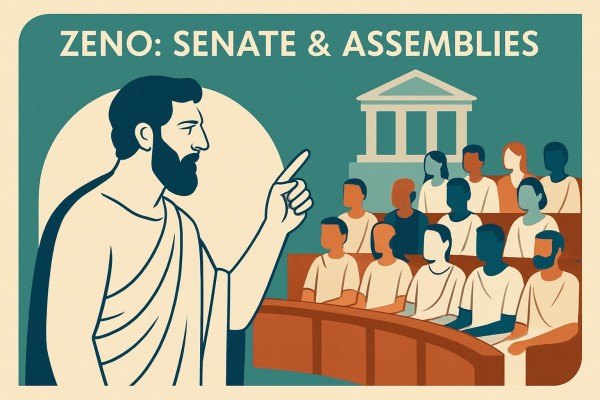
To understand how Stoic disciplines could enter the halls of the Senate or influence the popular assemblies (the Comitia and Concilium), it is useful to start with the Stoic conception of virtue. Zeno taught that virtue — understood as wisdom and the proper alignment of desire, aversion, and judgment — is the sole good. In republican Rome, where political honor and familial legacy often directed behavior, such an uncompromising ethical axiom offered both a critique and an ideal. Consider a senator who, guided by Stoic precepts, places duty above factional gain; or a magistrate who accepts exile or execution rather than violate conscience. These are dramatic images, but they are not without historical echo in later Roman figures who explicitly wore Stoic robes of principle.
Stoicism supplied vocabulary — terms like oikeiosis, oikeiôsis, oikeion, and logos — that Roman orators and jurists repurposed when discussing natural justice, obligations between citizens, and the moral character expected of officeholders.
Transmission matters: Zeno's school gave rise to later Stoics such as Cleanthes and Chrysippus, and their works were read and taught across Hellenic circles. By the time the Roman Republic reached its late stages, Greek philosophical instruction had become an essential attribute among the Roman elite. Figures like Panaetius and Posidonius — Stoic thinkers active during the Hellenistic-Roman interchange — adapted Stoic doctrines in ways that were politically palatable for Roman audiences. Panaetius, in particular, softened some of Stoicism’s rigid stances and emphasized pragmatic ethics, which resonated with senators who needed counsel on civic prudence rather than austere asceticism.
In senatorial debates, the Stoic insistence on universal reason and natural law could be marshalled to argue for impartial administration, equitable taxation, or humane treatment of allies and subjects. “Law of nature” rhetoric, when invoked by a Stoic-minded speaker, offered a counterweight to strictly patrimonial claims. In assemblies, appeals to shared human dignity and the common good could, at moments, transcend the narrow parochialism of clan politics — though often only in rhetoric.
The institutions themselves shaped reception. The Roman Senate was not a purely philosophical forum; it was a political body characterized by patronage, ritual, and a complex mixture of senatorial imperium and auctoritas. The assemblies conversed in a different language: crowd psychology, spectacle, and direct appeals. Stoic teachings, which prized inner control and rational assent, sometimes clashed with the performative, emotive space of the Comitia. Yet the assemblies could serve as amplifiers when a Stoic senator harnessed public virtue as a political lever: a speech whose moral clarity cut through partisan fog could sway votes and change the tenor of public policy.
An important vector for Stoic influence was law and jurisprudence. Roman jurists and legislators often articulated principles that resemble Stoic natural law: concepts of fairness, reciprocal duties, and obligations rooted in nature rather than sheer custom. Zeno’s emphasis on reason as the ordering principle of the cosmos lent philosophical gravity to such legal claims. When popular assemblies ratified laws or when the Senate issued senatus consulta, Stoic-based arguments about the moral legitimacy of measures occasionally surfaced, especially in debates over the rights of citizens and the governance of provinces.
Civic Virtue and Personal Example
Stoicism is distinctive for its practical emphasis: philosophy as a guide to daily conduct. In the Roman Republic, public examples mattered. A senator who practiced restraint in consumption, who accepted the rule of law with humility, who refused bribes or public intimidation — these behaviors signaled ethical leadership. Stories of Roman leaders who embodied such virtues, whether idealized or real, circulated widely and shaped normative expectations. The Stoic model of the wise statesman, detached yet engaged, aligned with Roman ideals of gravitas and stoic self-command (in the moralized sense).
Still, tensions are inevitable. Stoic cosmopolitanism — the idea that all humans are members of a single community — clashed at times with Roman nationalism and the privileges of citizenship. Senate debates that prioritized Roman prerogatives over universal reciprocity exposed the friction between Stoic moral cosmology and realpolitik. Furthermore, Stoic insistence on inner freedom could be interpreted as indifference to civic duty if misapplied; critics accused some adherents of aloofness or contempt for communal bonds. These debates sharpened both Stoicism and Roman political theory, shaping a discourse where moral philosophy and institutional necessity negotiated terms.
Rhetoric served as the bridge. Roman orators, schooled in Greek education, learned to translate Stoic categories into persuasive devices. An appeal to "right reason" or "rectitude" in the Senate might cloak a legal argument in moral authority, while a forceful public speech in the assemblies could frame policy as a duty rather than mere expediency. Stoic ethics supplied metaphors and motifs — endurance, duty, self-mastery — that became staples of Roman political oratory. When magistrates invoked such ideas, they were often signaling an ethical legitimacy that reached beyond short-term advantage.
Historiographically, we must be cautious. Zeno's direct presence in Roman Republican politics is an imaginative projection; his immediate disciples were Greek, and it was through intellectual intermediaries that Stoicism entered Roman life. Yet the cultural permeability of the Mediterranean world made such transmissions plausible. The late Republic, a time of intense moralizing literature and political experimentation, provided a stage where Stoic themes could be adopted, contested, and transformed. Roman adaptations were never carbon copies: they were creative appropriations that blended local values with Hellenic moral theory.
Consider illustrative scenes: a tribune in the assembly invoking the Stoic notion of conscience to justify vetoing a law seen as unjust; a consul speaking in the Senate about restraint and measured action in prosecuting a foreign campaign; an elderly senator choosing exile rather than betray a fellow citizen — each a dramatic enactment of Stoic principles converted into political action. These moments, whether actual history or plausible reconstruction, illuminate how ideas move from private reflection to public institution.
The stylistic interplay also invites reflection. Stoic sobriety meets Roman pageantry: ritual, togas, processions, and public spectacle; yet beneath that surface lies philosophical discourse. Senatus consulta, speeches, legal maxims, and funeral orations became carriers of a moral vocabulary infused by Stoic categories. The assemblies, noisy and unpredictable, sometimes amplified Stoic moralism by translating it into popular sentiment. In other moments, they resisted it, preferring pragmatic bargains and immediate benefits. Such oscillations reveal the democratic tensions within a republic that prized both civic duty and competitive advantage.
For readers fascinated by the collision of idea and institution: imagine Zeno’s calm logic echoing in corridors of power, a voice insisting that statesmanship must not only command but also be just.
This exploration has intentionally blended careful scholarship with imaginative extrapolation. The historical record shows that Stoic ideas influenced Roman thinkers; the creative exercise is to map how those precepts might reshape deliberation within the senate and the charged forums of the assemblies. The result is not a single, definitive history but a textured hypothesis: that a philosophy born in an Aegean port could, over generations, come to inform the ethical grammar of a republic built on custom, law, and civic spectacle.
Whether in a senatorial decree or a speech at the rostra, the Stoic call to align action with reason and to place the common good over private advantage offered a persistent counter-narrative to the centrifugal forces of faction and ambition. For those who sought to reconcile personal integrity with public power, Stoicism presented an attractive moral architecture: resilience in the face of fortune, steadfastness amid turmoil, and an ethic that elevated duty to an almost sacred status. These resonances — philosophical, rhetorical, and institutional — make the relationship between Zeno's school and Roman republican practice a subject both rich and enduring.
Closing reflection:
Stoicism's greatest gift to Roman public life may have been its insistence that governance is more than procedure: it is moral formation. When senators contemplated law, when citizens gathered in assembly, and when magistrates administered justice, they operated within a civic theatre where ethical argument could alter outcomes. Zeno's ideas, transmitted and transformed by successive teachers, contributed vocabulary and principles that could be invoked to contest power, justify reform, or console the defeated. The Stoic legacy in the arena of the senate and assemblies thus stands as a reminder that political institutions are always, in part, moral communities — shaped by ideas as much as by constitutions.
마지막 단락 — 요약:
제노의 스토아 철학은 직접적으로 공화정의 회의들 속에서 발생한 것은 아니지만, 그의 윤리적 원리들은 로마의 정치 문화에 깊은 영향을 미쳤다. 특히 덕과 자연법, 이성을 중시하는 관점은 원로원과 주민총회에서 제기되는 도덕적 논쟁의 근거가 되었고, 정치적 결정들을 윤리적 정당성의 관점에서 재구성하게끔 했다. 스토아적 이상은 개인의 자기통제와 공적 책임을 강조하며 공화정의 규범을 보완했고, 이는 공적인 삶이 단순한 제도적 절차를 넘어 도덕적 공동체 형성의 장이라는 점을 상기시킨다.
댓글목록0