Zama: Rome's Military Victory

 운영자
운영자
본문
Zama: Rome's Military Victory
A sweeping account of the decisive clash that shaped the late Republican Mediterranean world.
Context and Stakes
In the final acts of the protracted conflicts between the Italic city-state powers and their opponents beyond the sea, one battle stands out for its immediacy of consequence and clarity of outcome: the meeting at Zama, fought in 202 BCE. This was not merely a clash of armies; it was a collision of military systems, political futures, and reputations. At stake were the prestige and strategic reach of Rome, the survival and influence of Carthage, and the fate of the great commanders whose names would either ascend into legend or fade into reproach.
The battlefield itself, located on the North African plain, became the theater where Scipio — a Roman commander whose ambition and reforming zeal had already carried the war to enemy soil — confronted Hannibal, the Carthaginian general famed for the audacity of his Alpine crossing and the string of victories he had wrought on Italian ground. Their encounter at Zama synthesized years of campaigning, diplomacy with regional powers (notably the Numidian cavalry leaders), and shifts in military organization and doctrine.
Prelude: Maneuver, Alliance, and Preparation
The months leading up to the battle were characterized by diplomacy and calibrated aggression. Scipio secured the allegiance of the Numidian prince Masinissa, whose light cavalry were indispensable in countering Carthage's own horsemen. It is worth noting that cavalry — mobile, disruptive, and decisive in open terrain — would prove a pivotal element. Both sides trained and arrayed their forces with awareness of each other's strengths: Carthage leaned upon Hannibal's experienced infantry and the shock value of war elephants; Rome sought to exploit disciplined maniples, cavalry superiority, and innovative battlefield signaling.
"The general who understands timing and terrain can bend numbers to favor." — tactical maxim often cited by contemporary chroniclers
Polybius and Livy, writing from different vantage points and with different emphases, both emphasize the psychological dimension. Hannibal's return to Africa was an attempt to throw Rome from its pedestal; Scipio's advance to the enemy heartland sought to force a decisive battle rather than a long attritional contest. From the moment formations drew up, it was evident that the clash would hinge on commander control, troop reliability, and the capacity to exploit openings as they appeared.
Deployment and Tactics: How Zama Was Fought
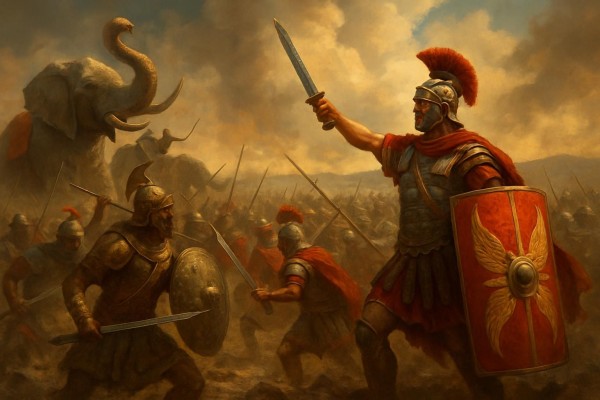
The two armies arrayed in thoughtful and deliberate order. Hannibal employed a depth of infantry and a forward screen that included elephants, intended to break Roman lines and create disorder. Scipio, anticipating the elephant threat, orchestrated countermeasures: lanes and gaps, rapid missile volleys, and a psychological composure that denied the elephants the chaos they sought to sow.
When the elephants charged, disciplined Roman cohorts opened corridors, allowing the animals to pass through with minimal disruption. Javelins, caltrops, and well-timed volleys converted the charging animals into manageable inconveniences or removed them entirely from the field. Scipio's cavalry — bolstered by his Numidian allies — executed the decisive maneuver: after initial infantry engagements, they struck the flanks and rear of Hannibal's formations, routing supporting units and preventing the reformation of Carthaginian lines.
Hannibal's tactics were informed by deep experience, but on that day they met a Roman commander who adapted faster than the Carthaginian force could respond. The disciplined reserves, the well-timed cavalry charges, and the ability to hold compact blocks until the decisive moment combined to produce a result that was not merely tactical but strategic: the shattering of Carthaginian field capability and the loss of their capacity to wage war on equivalent terms.
Leadership and Command
The contrast of leadership at Zama is instructive. Scipio exhibited an ability to synthesize intelligence, to trust subordinate commanders, and to innovate under pressure. His tactical imagination — training troops to cope with elephants, employing cavalry at the opportune moment, and managing reserves with precision — marked him as more than a product of Roman military tradition; he was an innovator within it.
Hannibal, for all his battlefield brilliance, faced material disadvantages: fewer reliable cavalry, the political constraints of a city under pressure, and the cumulative cost of years of campaigning. His tactical instincts were superb; his strategic options were narrowing. At Zama, tactical genius could not fully compensate for disparities in support and situational control.
Immediate Aftermath
The aftermath of Zama was abrupt and consequential. Carthage sued for peace; the terms imposed by Rome were severe and reshaped Mediterranean power relations. Financial indemnities, territorial restrictions, and the loss of overseas holdings stripped Carthage of the ability to regain the military position it had once held. For Rome, victory meant supremacy: naval prerogatives, political leverage, and the prestige to assert influence across the region.
Scipio returned to Rome hailed as Africanus: the conqueror of Africa. His personal star rose markedly, but with success came political scrutiny. Victories of such magnitude altered the balance of domestic power back home; generals became symbols as much as functionaries of the state. Hannibal's legend persisted, albeit in a diminished polity; he would later serve as a statesman and advisor, continuing to influence affairs until the final extinction of Carthaginian autonomy.
Long-Term Significance
Zama's outcome accelerated transformations already underway in Roman military doctrine and political life. The capacity to project organized, disciplined power across distant theaters, allied with adept diplomacy (as with the Numidian negotiations), foreshadowed how Rome would consolidate its Mediterranean hegemony. The war indemnities and territorial dispossessions fundamentally weakened rival city-states and paved the way for new commercial and colonial patterns dominated by Roman interests.
In military-historical terms, Zama taught enduring lessons about combined-arms operations, the management of reserves, and the careful mitigation of shock elements such as war elephants. It also underscored the importance of logistics and alliances — factors that too often determine victory long before swords are drawn.
Sources, Memory, and Myth
Our understanding of Zama comes primarily from a handful of ancient historians, notably Polybius, who aimed for an analytical style, and Livy, whose narrative emphasizes moral and political lessons. Later tradition amplified the heroic and tragic dimensions of both commanders. Modern scholarship interrogates these narratives: analyzing biases, comparing archaeological data, and reconstructing dispositions. Such work complicates received myths even while celebrating the drama of the encounter.
Tactical Takeaways for Modern Readers
- Adaptation: Success depended on anticipating and countering unique threats (elephants) rather than applying rigid formulas.
- Alliances: Cavalry allies changed the balance of pursuit and exploitation.
- Reserves: Controlled reserves and timely commitment proved decisive.
- Psychology: Discipline under stress neutralized shock weapons and preserved order.
These timeless lessons, while expressed in the idiom of ancient warfare, echo across centuries: commanders who prepare, adapt and manage human factors reliably outperform those who depend solely on past glory.
Cultural Resonance
The story of Zama appears in literature, art, and public memory as a hinge moment. Paintings and heroic poems recast the day as moral demonstration as much as military triumph. In classrooms and strategy seminars it remains a potent case study: how resources, leadership, and the management of battlefield uncertainty translate into historical consequence.
Conclusion: The Legacy of a Decisive Field
The clash at Zama did more than terminate one phase of hostilities; it ushered in an era in which Roman strategic reach became the dominant organizing principle of the western Mediterranean. Military technique, allied politics, and the fortunes of states converged in a single day to produce a result that shaped the next centuries of history. Looking back, one can read Zama as both the culmination of a long-running rivalry and the point from which a new balance of power emerged — a reminder that on certain plains, decisions tilt the scales of time.
Further Reading and Notes
For those seeking deeper engagement, primary accounts by Polybius and Livy remain invaluable, though they must be read critically. Modern treatments synthesize archaeological findings and comparative studies of ancient tactics. Consider works that examine the logistical and political context as much as battlefield narratives.
Tags and cross-references are provided below to guide exploratory reading.
요약: 전투에서의 기동력, 외교적 연합, 그리고 지휘의 융통성은 승패를 갈랐습니다. 장기전의 부담과 정치적 제약 속에서 카르타고는 재건할 수 없는 타격을 입었고, 로마는 지중해 서부에서 패권을 확립했습니다. 전술적 교훈은 고대의 것이지만 현대에 이르기까지 조직, 예측, 그리고 순간의 판단이 가지는 중요성을 여전히 일깨웁니다.
댓글목록0