Triremes of the Roman Republic

 운영자
운영자
본문
Triremes of the Roman Republic
An ornate exploration of design, crew, tactics and legacy of one of antiquity's premier warships.
Introduction
The trireme stands among the most iconic vessels of the ancient Mediterranean: a sleek, fast, and purpose-built war galley whose three banks of oars defined naval power for centuries. Although modern popular imagination most often links triremes to the Greek city-states, their influence and practical use extended into the naval practices of the Roman world during the Republican era. This essay walks through the construction, crew composition, tactical employment, and broader cultural legacy of the trireme as it functioned in the context of the Roman Republic.
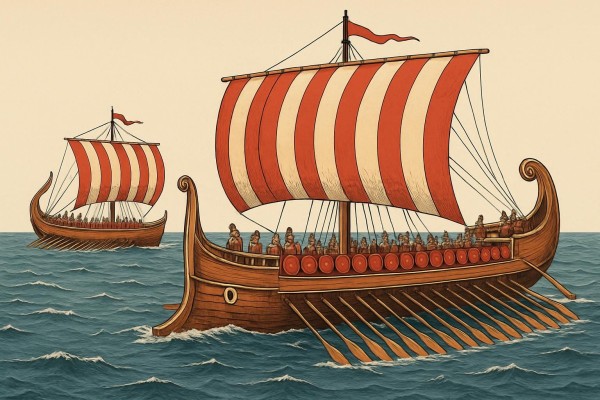
Anatomy of the Trireme
At its core, the trireme was engineered for speed and maneuverability. The hull was long and narrow, often carvel-built or edge-joined in wood types like pine for the planking and oak for frames. The defining feature — three tiers of oars — gave the ship its name and complicated the internal layout considerably. Each oarsman sat on a separate bench level or, in practice, staggered footwells and platforms were used to fit three rows in a constrained vertical height.
The ram (rostrum) fitted to the prow was usually bronze-faced and designed to punch holes beneath an opponent's waterline. Efficiency of power transmission from human muscle to hull movement required hull-hugging oarports and minimal freeboard.
Construction employed sophisticated joinery. Planking was fastened with treenails and metal nails where necessary; frames were faired to produce the required hydrodynamic form. The mast and sail were primarily for cruising and transport; in battle, sails were often furled and dropped to avoid entanglement with enemy ships.
Crew, Command, and Social Composition
A typical trireme carried about 170 men: roughly 170 rowers could be the case in larger, fuller crews, while some reconstructions suggest fewer depending on local practice. That figure includes officers, a helmsman, a lookout, marines for boarding actions, and the oarsmen themselves. The social composition fluctuated: in early Mediterranean practice, trained, free citizens often provided the manpower; later, especially in Roman contexts, allied contingents, freedmen, and even short-term conscripted sailors increased the pool of manpower.
Officers on a trireme were a small, tightly-knit leadership: a trierarch or ship commander, a naval prefect or equivalent, and several petty officers who trained and organized rowing rhythm, discipline, and battle orders.
Coordination among oarsmen relied on percussive signals — flute and drum — and shouted commands. The physicality of the job, the cramped conditions, and the need for perfect harmony made experienced crews far superior to ad hoc conscripts.
Note: while archaeological finds of complete triremes are rare, experimental archaeology and preserved iconography (vase-paintings, reliefs, coinage) give modern scholars rich clues about proportions and crew layout.
Tactics and Battle Doctrine
Triremes were the tactical answer to close-quarters naval dominance. They specialized in ramming (embolon) and in maneuvers like the diekplous and periplous — thrusting through gaps or circling to strike flanks. In the Roman Republic, early naval engagements borrowed heavily from Greek and Carthaginian tactics; Rome's later adaptations included boarding maneuvers supported by troops trained for amphibious assault.
Because triremes depended on human endurance, battles favored short, decisive clashes at dawn or with favorable wind conditions when crews remained fresh. The Romans, pragmatic in naval evolution, progressively added heavier deck structures to support marines, while also experimenting with larger polyremes for extended reach and combat sustainability.
Logistics, Maintenance and Ports
Triremes required intensive maintenance: frequent caulking, hull care, and replacement of oars and rigging. Naval bases — naval arsenals like the later Roman "navalia" — served as hubs for repair and crew training. Because speed was paramount, triremes were often stored ashore on slips or in sheds and launched only when required.
Ports functioned as:
logistics nodes, recruitment centers, and tactical reserves
Archaeology and Sources
Primary sources for trireme studies include ancient authors (Thucydides, Polybius, Livy), iconography, and a handful of preserved hull remains from other Mediterranean contexts. The Roman Republic's naval records, often fragmentary, must be read in parallel with material culture. Experimental projects — built trireme reconstructions — have tested hypotheses about speed, crew size, and handling, giving tangible insights that texts alone cannot provide.
Cultural and Strategic Legacy
In the larger sweep of naval history, triremes represent a transitional technology: they codified the combination of human power and hull design that dominated the classical seas. For the Roman Republic, mastery of such vessels was a strategic necessity in wars with maritime foes and in controlling trade routes. Culturally, the trireme appears in Roman art and commemorative coinage, symbolizing victory and state power.
Modern reinterpretations — in museums, films, and scholarly reconstructions — often highlight the discipline and organization that made trireme warfare possible. The image of perfectly-timed oars cutting the sea in unison remains a potent emblem of ancient naval superiority.
Reconstruction Experiments and Modern Sailings
Experimental reconstructions have shown that a well-trained trireme crew could produce bursts of remarkable speed — sometimes reportedly over 9-10 knots for brief periods — but sustaining such performance depended on careful rationing of human exertion. These projects have also illuminated how delicate the balance of weight, oar geometry, and hull shape is for achieving top speed without sacrificing structural integrity.
Contemporary revivals of trireme-sailing demonstrate more than just seafaring skill: they reconnect modern audiences to the lived realities of ancient naval life, from cramped benches to the cries of helmsmen and the thrum of oars.
Design Lessons for Modern Naval Architecture
There are practical lessons that echo into modern naval thought: the premium on reducing weight and drag, the value of centralized human coordination in systems design, and the way that tactical doctrine is shaped by the physical constraints of a platform. While materials and propulsion have evolved, the trireme's elegant solution to coastal dominance provides a study in efficiency and ergonomic engineering.
Final Reflections
The trireme, in the context of the Roman Republic, should be understood as both a technological artifact and a social one. It demanded investment in training, infrastructure, and logistics — and rewarded those who mastered it with control over maritime corridors. Whether viewed as an instrument of statecraft, a crucible for human cooperation, or a masterpiece of nautical engineering, the trireme endures as an emblem of a world in which speed, skill, and seamanship decided empires.
Further Reading and Resources
If you wish to pursue this topic further, consult translations of Polybius and Livy, specialized journals in maritime archaeology, and publications on experimental reconstructions. Museums with Mediterranean collections often display models and reliefs that help visualize these ships in three dimensions.
Digital archives and 3D models are increasingly useful — look for open datasets from maritime archaeology projects and university repositories.
요약: 본문은 공화정 시대의 전통적 노선 전투선의 설계와 운영, 승무원 구성, 전술적 활용 및 보존 증거에 관해 다룹니다. 핵심은 속도와 기동성, 노와 선수(램)를 이용한 결정적 충격, 그리고 이를 뒷받침한 보급과 항구 기반의 중요성입니다. 복원 실험과 고고학적 자료는 고대 해군술의 실제를 이해하는 데 중요한 단서를 제공합니다.
댓글목록0