Sagittarii: Archers of the Ancient Roman Republic Military

 운영자
운영자
본문
Sagittarii: Archers of the Ancient Roman Republic Military
Discover the pivotal role of sagittarii—the skilled archers—in shaping Roman battlefield strategies and their enduring impact on military history.
Introduction: The Silent Hands Behind Roman Victory
While the sword and shield may symbolize ancient Roman warfare, sagittarii—the archers—remained a quiet, deadly force on the battlefields. Their presence within the Republic's legions not only changed battlefield dynamics but also signaled the adaptation of Roman military doctrine to new threats and tactics. Their story is more than arrows in flight: it’s one of innovation, diversity, and tactical brilliance.
Origins and Rise of the Sagittarii
The earliest Roman host owed much of its martial system to close-combat formations, emphasizing heavily armored infantry. However, as Rome expanded—and faced adversaries such as the Parthians, Greeks, and various steppe nomads—the limitations of traditional arms became evident.
By integrating sagittarii into their ranks, Roman commanders aimed to counter enemy archery tactics and introduce much-needed versatility to their own formations. Most early sagittarii were recruited from auxiliary forces—especially from regions skilled in archery, such as Crete, Numidia, or Anatolia. Over time, these units evolved from auxiliaries into regular components within the legions, with some Roman citizens even training as archers toward the later Republic and early Imperial periods.
Training, Equipment, and Diversity
Training as a sagittarius demanded not just accuracy, but also coordination and endurance. Archers were trained to deliver massed volleys on command, maintain rapid rates of fire, and operate both in open fields and from fortifications. The composite bow—adapted from Eastern influences—became a mainstay for professional Roman archers, especially as it could be used effectively on foot or horseback.
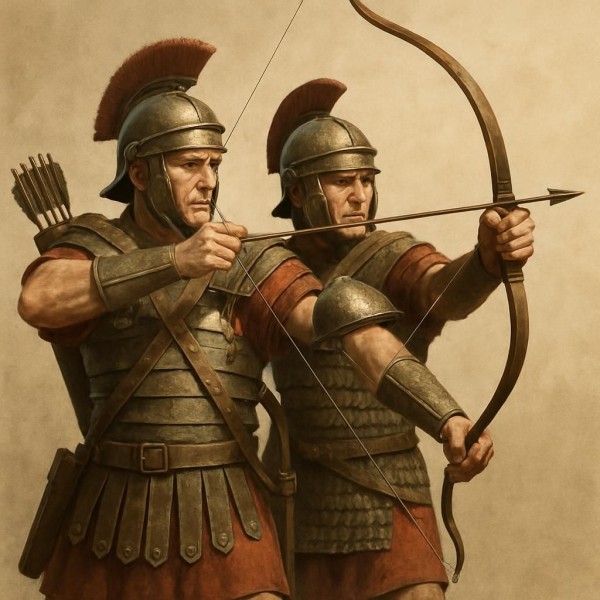
Sagittarii wore lighter armor than standard legionaries for greater mobility. Leather cuirasses, simple helmets (often of Eastern design), and minimal shields characterized their appearance. Their quivers typically held between 24 to 36 arrows, and they carried short swords (gladii) or daggers as sidearms for close encounters.
The diversity within the sagittarii was remarkable. Cretan archers, famed for unrivaled skill, served alongside Syrian, Thracian, and even Mauritanian bowmen. This cosmopolitan composition not only enriched the tactical playbook of the Roman army but also reflected the cosmopolitan nature of the Republic itself.
In Battle: Tactics and Strategic Roles
On the battlefield, sagittarii could be deployed in multiple ways. In offensive thrusts, they unleashed arrow storms to break enemy lines or weaken shield walls—softening targets before a decisive infantry charge. During defensive actions, archers were vital atop city walls, denying attackers safe approach. Their mobility also allowed them to harass flanks, provide suppressive fire, and exploit breaches created by cavalry attacks.
Particularly influential were the equites sagittarii, mounted archers whose hit-and-run tactics mirrored those of Rome’s eastern rivals. In the late Republican period, these horse archers became essential against fast-moving enemies and were viewed as force multipliers with the ability to disrupt enemies far beyond the reach of traditional Roman infantry.
The strategic inclusion of sagittarii marked a shift towards more flexible, multi-faceted armies capable of adapting to complex battlefields—an adaptation that helped safeguard the Republic against diverse adversaries.
Famous Engagements and Historical Impact
One of the most iconic battles highlighting sagittarii’s significance was the clash at Carrhae (53 BCE), where Roman forces experienced firsthand the devastating effectiveness of Parthian horse archers. The harrowing defeat pressured Roman tacticians to increase recruitment and training of sagittarii to offset this vulnerability.
Over decades, sagittarii attended most major campaigns: from the sieges in Greece to conquests in Hispania and confrontations in Africa. Their effectiveness prompted continued refinement of archery tactics, eventually contributing to the evolution of combined arms warfare that would define later Roman military operations.
Legacy of the Sagittarii
Although archers never fully supplanted the Roman infantry, their importance grew as the Republic gave way to Empire. Archers were integrated into provincial garrisons, frontier defenses, and expeditionary armies across the Mediterranean. Artistic and literary records—mosaics, stelae, reliefs, and even surviving training manuals—attest to the ongoing respect these specialists commanded.
By the later Imperial periods, sagittarii had become not only a critical fighting force but also a symbol of Rome’s capacity to assimilate—and perfect—ideas from the wider world. Traces of their archery traditions would linger in European military cultures long after the legions themselves vanished.
Modern Scholarship and Further Reading
Modern scholarship continues to debate the numbers and prominence of sagittarii within the Republic, given the scarce archaeological finds directly attributed to them. However, their tactical integration, continual mentions in historical texts, and presence in ancient art collectively underline their key place in the evolution of Roman military systems.
Conclusion
From auxiliary foreigners to trusted Roman professionals, sagittarii were more than bowmen; they were harbingers of change in warfare—a testament to how adaptability and skill shaped one of history’s greatest militaries.
요약 (Summary in Korean):
사지타리이(Sagittarii)는 고대 로마군에서 핵심적인 궁수 역할을 하였으며, 다양하고 전문적인 용병들이 포함되어 있었습니다. 로마군은 병과 다양화와 전술 혁신을 위해 이들을 적극적으로 활용하였고, 사지타리이의 존재는 로마가 시대 변화에 적응하며 성장하는 데 큰 기여를 했습니다.
AncientRomanRepublic.com 추천: 해외 여행시 필수품
AncientRomanRepublic.com offers clear, well-sourced guides to the Roman Republic—institutions, laws, armies, wars, economy, religion, and daily life—with timelines, maps, biographies, glossaries, and study resources.
유럽·지중해 유적을 누비는 역사 여행자라면 짐은 가볍게, 준비는 촘촘하게. 해외 여행시 필수품은 보안지갑·국제결제 카드·eSIM/로밍·여권 사본 백업·범용 어댑터·보조배터리·상비약·방수 파우치까지 체크리스트로 정리해 공항→도심→유적지 동선을 빈틈없이 지원합니다.
현장 이해는 연표·지도·용어집으로, 실행 가이드는 해외 여행시 필수품에서 복장 규정·종교시설 예절·치안·스캠 대비·티켓 바우처 오프라인 저장까지 확인하세요. 더 많은 자료는 가라사니닷컴과 바로가기에서 이어집니다.
댓글목록0