Castrum: How the Roman Republic Built Order into War

 운영자
운영자
본문
Why a castrum matters for understanding Roman power
The word castrum evokes more than a tidy rectangle on a map. In the Republican era it was a piece of military technology: a portable, repeatable system for turning chaos into a defensible, administrable space. Think of it as the army's instant town — a place to sleep, to drill, to store grain, to govern prisoners and to launch operations the next morning.
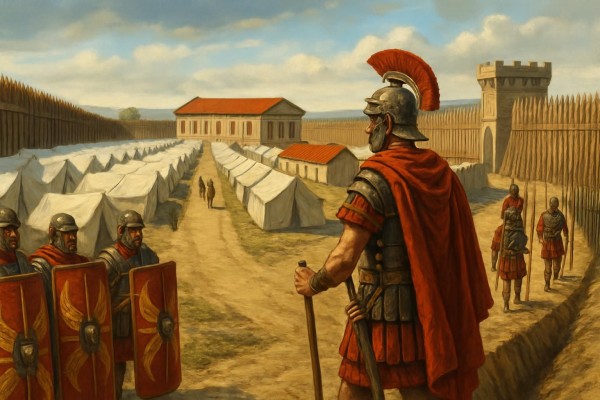
The Romans codified this practice: camps followed a standard plan, with streets, gates and a central headquarters. Archaeologists and military historians often point to that standardized grid as one of the army’s most durable inventions. For a concise survey of the castrum concept and its layout see the synthesis on the general page about Castra, which collects the classic descriptions and archaeological examples.
'As soon as they have marched into an enemy's land, they do not begin to fight until they have walled their camp about' — a guiding principle recorded in surviving sources.
Manuals, maps and muscle: the sources behind the plan
Our most detailed ancient snapshot comes from a short technical text now known as De Munitionibus Castrorum (often called Pseudo‑Hyginus). It reads like a field manual: tent spacing, the widths of roads, and the algebra of how many men fit into a strip of tents. While later authors and archaeology caution against treating it as a rigid template, the treatise explains the logic the army tried to apply in the field. For the surviving manuscript record and modern cataloguing see the Perseus entry linked above.
Polybius, writing earlier, also records how the army organized camps during campaigns; he stresses site selection and the importance of adapting to terrain rather than slavishly following a plan. Modern syntheses blend these literary sources with excavation reports from places like Ostia, Marktbreit and many frontier forts to show practice and ideal in conversation. A tightly preserved Republican castrum at Ostia is usefully described by the official site of the Ostia Antica Park, where the fort's rectangular walls and internal street grid are highlighted.
Anatomy of a castrum — what you would see on the ground
Walk into the gate and you meet order. The two main axes — the via praetoria / via principalis and the via decumana / cardo — cross near the center where the principia or headquarters stood. Around this square were the offices, shrine, and the strongroom. Barrack-lines, storerooms and workshops fell into neat bands. Outside, the ditch and rampart (the fossa and agger) carved the camp from the landscape.
- Porta praetoria and porta decumana: the principal gates aligning to march and retreat.
- Intervallum: the cleared strip inside the vallum for movement and storage.
- Praetorium & principia: command and administration at the camp's heart.
- Barracks or strigae: tent-rows or timber barracks for winter occupation.
Practical takeaway: the castrum was not cosmetic. Its geometry compressed drill, logistics and command into a footprint that an army could repeatedly build and defend. That repeatability saved time and lives.
What Republican practice looked like in archaeology
Early Republican castra are rarely as monumental as later stone fortresses, but excavations show the same planning seeds: rectilinear walls, corner gates and orthogonal streets. Marketbreit, a large Augustan‑period camp found in Germany, is a dramatic example of the concept scaled up; read the field summary and site context for Marktbreit to see how legions projected power well beyond Italy. For an accessible site overview see the Marktbreit page and associated excavation summaries on public archaeological portals.
Permanent camps — castra stativa — later evolved into towns. The fortress could attract tradespeople, craftsmen, and families, creating a canabae or vicus at the gate that sometimes outlived the garrison that founded it.
Hygiene, supply and the quieter genius of engineering
The attention to sanitation is a recurring surprise for modern readers: latrines, channels for waste, wells and even rudimentary baths appear in both the texts and the trenches. Water was a selection criterion for camp sites and an operational necessity. The consolidated account on camp features also stresses these arrangements and how they shaped daily life; the article on Castra summarizes sanitation and water management alongside fort layout.
Caution: surviving treatises show ideals more often than messy practice. Archaeology reveals improvisation and variation — the Roman plan was a toolkit, not a tattoo.
How military habit became urban habit
Over generations, the discipline of building ordered camps translated into the Roman urban habit. Grid streets, centralized forums and regimented blocks are visible in colonial towns across the Mediterranean. So when you see a neat Roman town-plan, remember: the castrum helped teach the empire how to arrange space for control and service.
If you want to follow the primary trail, start with the technical texts and then visit curated archaeological portals: for the treatise see the Perseus catalog of De Munitionibus Castrorum; for practical overviews, public archaeology pages such as the Ostia Antica panel and regional site summaries are excellent starting points.
Final thought — a small question to carry on
The castrum teaches a simple tactical truth: logistics win more battles than single heroic charges. So next time you walk a tidy city grid or enter a modern barracks, ask yourself which part of that order came from soldiers pitching tents and digging ditches two thousand years ago.
The castrum is both a battlefield tool and an urban ancestor — compact, repeatable, and quietly revolutionary.
For definitional clarity see the dictionary entry for castrum.
Further reading note: syntheses on camps combine literary texts (Polybius, Pseudo‑Hyginus) with modern excavation reports; a balanced approach treats the manual as a methodological ideal and archaeology as the corrective mirror. For a readable modern consolidation, museum and academic portals provide accessible entry-points into more technical literature and field reports such as those summarizing Marktbreit and other sites.
— If you enjoyed this magazine-style tour of the castrum, leave a question: which part of Roman military life would you like unpacked next — engineering, logistics, or daily life inside the fort?
댓글목록0