Faces of the Late Republic: How Cicero, Pompey and Crassus Keep Shapin…

 운영자
운영자
본문
Opening: Why look at personalities, not just politics?
When we say “Ancient Roman Republic,” most people imagine wars, laws, and dramatic fall-from-grace narratives. But the Republic was also a theatre of crafted faces: orators, generals and moneyed patrons who curated their images in stone, print and, now, on screens. This piece connects three notable figures — Marcus Tullius Cicero, Gnaeus Pompeius Magnus (Pompey), and Marcus Licinius Crassus — through two linked threads: modern scholarship/exhibitions that reframe them, and the visual and cultural languages that made their reputations endure.
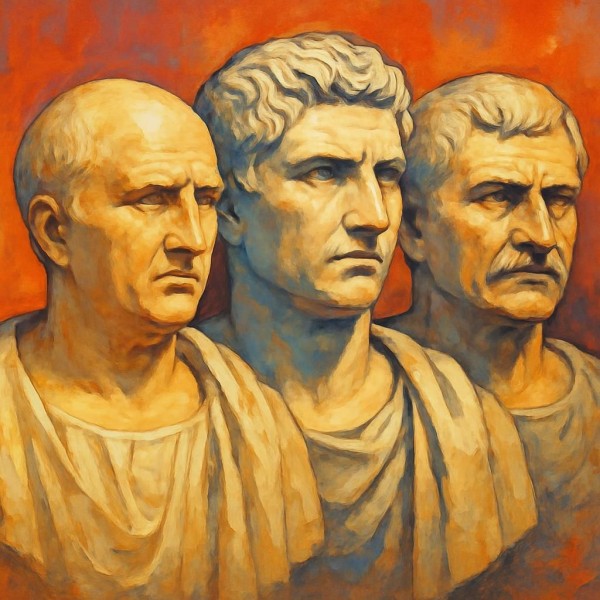
1) Cicero — the orator as public philosopher
Recent popular-level scholarship treats Cicero not only as a courtroom genius but as a thinker whose writings are being mined for contemporary political reflection. Vittorio Bufacchi’s short book argues that Cicero’s blend of rhetoric and Stoic-influenced ethics can help us think about civic duty and democratic resilience today. You can read the publisher’s overview for context in his Bloomsbury page.
This is not hagiography: many reviewers point out Cicero’s contradictions — eloquent on duty yet conservative on economic redistribution — and that tension is precisely why modern writers use him as a lens for ethical debate.
Quick takeaway: Treat Cicero as a case study in how a statesman uses prose to build legitimacy — and how later readers repurpose him to address modern civic anxieties. (Source: publisher pages and academic reviews.)
2) Portraiture and the politics of verism — how Roman faces meant power
Portrait sculpture in the late Republic favored verism: unflinching realism that signalled age, experience and ancestral pedigree. Museums and online essays (notably the Metropolitan Museum’s Heilbrunn Timeline) show how a wrinkled, weathered visage could function as political communication — an assertion of gravitas and virtus rather than mere likeness. This visual vocabulary explains why a figure like Cicero cultivated a public face through writing and oratory while aristocrats invested in marble likenesses. (metmuseum.org)
In short: Roman portraiture was propaganda with texture. When curators today reinstall Republican-era sketches, busts and wax-imagery in exhibitions, they are also narrating the Republic’s social code. (metmuseum.org)
3) Pompey — a career seen anew
Pompey’s long career — naval command, eastern settlements and complex relations with the Senate and Caesar — continues to attract reassessment. Authoritative reference summaries outline his rise from provincial command to one of Rome’s most powerful men, and recent museum and exhibition programming has highlighted artifacts and numismatic evidence that complicate his popular image as simply Caesar’s foil. For background on Pompey’s trajectory and the conventional textbook overview, see the Encyclopaedia Britannica entry.
Museums now place Pompeian-era objects and Republican portrait heads in dialogue with later propagandistic images, prompting visitors to ask: did Pompey make Rome more secure, or did his self-fashioning accelerate elite competition? Recent curatorial notes and essays encourage visitors to hold both possibilities.
“Power in the Republic was a visual contract — what you looked like promised what you could do.”
4) Crassus and Carrhae — failure that reshaped reputations
Marcus Licinius Crassus is often remembered for his wealth and for the catastrophic Parthian campaign that ended at Carrhae (53 BCE). Standard reference treatments (e.g., Britannica’s articles on Crassus and the Battle of Carrhae) still provide the most accessible summaries of the campaign’s tactical and political consequences. Modern commentary emphasizes how a single military disaster can redefine a public legacy, and that redefinition is precisely the subject of recent popular histories and battlefield reconstructions.
Reading Crassus through Carrhae shows how reputational risk traveled across the Mediterranean — news, trophies and captives produced political fallout back in Rome that lasted decades.
Caution: Popular retellings sometimes compress nuance — archaeology and close reading of sources complicate any single “moral” about a life. Always check museum catalogues and specialist reviews for updates.
5) Why exhibitions and short books matter for the Republic
Cultural programming — from sketchbook-centred shows nominated as exhibition-of-the-year to concise books that popularize philosophical readings — is changing how non-specialists meet the Republic. For example, a recent exhibition that re-presented Roman sketchbooks and drawings has been highlighted by museum press releases and arts coverage as renewing attention to Rome’s visual culture. These public-facing formats invite new questions rather than simply re-stating textbook narratives. (smb.museum)
In practice, that means teachers, curators and podcasters are all re-mixing primary sources, museum objects and modern critiques — and each remix reshapes which Roman figures feel “relevant” to modern readers.
Final reflection — what to take home
Faces matter. The way Cicero wrote, Pompey presented himself in coins and statues, and Crassus’ defeat was narrated everywhere — together these aspects show that the Republic’s politics depended as much on image-making as on legislation or battlefield formations. Modern exhibitions and concise scholarship make those connections vivid for a public audience.
A single sentence: consider the Republic’s leaders less as fixed biographies and more as crafted public performances — performances still being edited today.
Further reading & curated links (open in new tab):
Want a short reading list tailored to beginners or to teachers preparing a module on “people and image in the late Republic”? Tell me which audience you have in mind and I’ll stitch a compact, dated list (links and quick notes included).
댓글목록0