Varro: Rome's Learned Scholar

 운영자
운영자
본문
Varro: Rome's Learned Scholar
An ornate exploration of a mind that bridged practical life and erudition in the Roman sphere.
Marcus Terentius Varro stands as one of the most prolific and systematic scholars of the Roman era. Born into the tumultuous decades that preceded the consolidation of imperial rule, he combined a practical eye for agriculture with an almost obsessive compulsion to catalogue, classify, and preserve knowledge. His encyclopedic ambition made him a figure whose works touched on language, religion, history, and farm management. To read Varro is to witness a Roman mind trying to reconcile the inherited traditions of the countryside with the intellectual currents of the city—an effort that has long intrigued historians, classicists, and anyone intent on appreciating how learned culture operated within the wider civic life.
In this essay I attempt a vivid, layered portrait — part biography, part intellectual map, part cultural appreciation.
Varro's output was vast, though much of it survives only in fragments and later citations. Works such as De Lingua Latina and Res Rusticae (sometimes rendered as De Re Rustica) reveal two complementary tendencies: a meticulous interest in language and philology, and a devotion to the art of farming. In De Lingua Latina, Varro sought to explain and rationalize the Latin tongue; in his agricultural treatises he offered a compendium of husbandry, veterinary advice, and rural economics. These are not mere technical manual and grammar book; they are mirrors of Roman values, illuminating how labor, speech, and ritual interwove in everyday life.
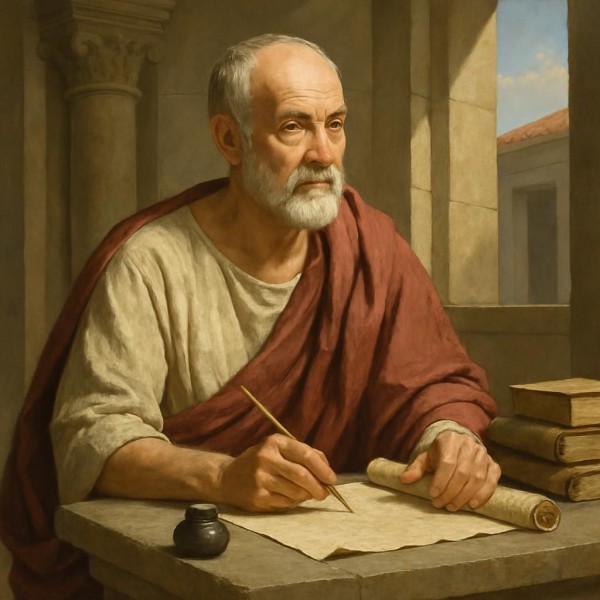
The range of Varro’s curiosity can be unsettling to modern readers who prefer tidy boundaries between disciplines. He moved effortlessly from etymology to agriculture, from calendar reform to religious superstition. His analytical habits show a proto-scientific rigor: attentive to sources, eager to categorize. Yet Varro was also a Roman conservative of sorts; he valued tradition and understood the stabilizing function of rites and institutions even as he dissected them. Such duality—an inclination to systematize combined with reverence for inherited practice—made Varro a linchpin in the transmission of knowledge from the late republic into later antiquity.
Varro could be both an archivist of the common and a theorist of the learned.
One of the enduring fascinations with Varro is his treatment of religion. In his lost treatise Antiquitates Rerum Divinarum and other fragments we find an attempt to explain gods, rituals, and sacred customs as part of a social framework. Varro famously categorized theology into three approaches — the mythical, the natural-philosophical, and the civil or political — thereby providing later readers with tools to parse the many faces of Roman religiosity. His willingness to analyze sacred tradition with critical methods unsettled some contemporaries but also ensured that his observations would be accessible to subsequent intellectuals engaged in reconciling faith, custom, and reason.
The agricultural works, addressed partly to landowners and partly to a literate Roman class keen on practical improvement, are a window into the economic foundations of the republic and its aftermath. Varro wrote about crop rotation, soil types, animal husbandry, estate management, labor organization, and even the economics of leasing land. His prose, pedantic to some degree yet generously informed, sought to systematize what had been a large body of localized know-how. In doing so Varro helped to preserve techniques and proverbs that otherwise might have disappeared with the decline of certain rural practices.
Practical wisdom in service of civic resilience.
Philology was another arena where Varro excelled. His methods anticipated later linguistic scholarship: he sought to trace the history of words, to establish correct usages, and to cleanse Latin of what he viewed as corruptions. But his philology was not an insular hobby; it was intimately connected to law, rhetoric, and education. Mastery of language mattered for public life in Rome; Varro’s linguistic studies therefore fed into a broader cultural project of preserving civic competence and verbal precision among the ruling classes.
Varro's social position — a man of property and of letters — fostered an approach that combined elite concerns with an often surprisingly democratic interest in the techniques of rural work. He did not romanticize peasant life, yet his attention to the details of toil acknowledged the foundational role of agricultural labor in sustaining Rome’s military and civic institutions. In times of political turbulence, when urban life and senatorial fortunes fluctuated, these rural networks remained a vital backbone. Varro’s writings, therefore, can be read as part of a larger effort to stabilize culture through the retention of practical knowledge and institutional memory.
He was both archivist and adviser: the learned friend of landholders and the cautious critic of ephemeral fashions.
Criticism of Varro often centers on his prolixity and his eclecticism. For some later readers, his tendency to compile rather than to synthesize made his corpus cumbersome. Yet precisely because he preserved so much — lists, quotations, marginal notes — Varro became indispensable to later antiquity and to medieval scholarship. When centuries later other texts were lost, Varro’s fragments often provided the only surviving testimony of earlier authors and lore. His compilatory instinct thus morphs into a kind of cultural insurance policy against the fragility of manuscripts and memory.
Another facet of Varro's influence is pedagogical. His works functioned as guides for cultivated Romans seeking orientation in an increasingly complex civic environment. Education in Rome was not merely literary; it encompassed an awareness of religion, agriculture, and public administration. Varro’s habit of addressing practical problems with learned methods made his books suitable for use in the education of administrators, estate managers, and aspiring magistrates who needed a broad, serviceable acquaintance with many domains.
A teacher for the republic’s managers, whether on the forum or in the field.
Beyond the immediate utility of his writings, Varro’s enduring legacy lies in his intellectual posture: an insistence that knowledge should be collected, ordered, and made useful. In an age where oral tradition and localized expertise risked being fragmented by war and social change, his methodical approach provided a bulwark against forgetting. He is therefore interesting not only for what he knew but for how he organized what he knew — a proto-encyclopedist whose labor paved the way for later reference traditions in the Latin West.
Reading Varro today requires patience, since so much is lost and what remains tends to be fragmented and dispersed across other authors' citations. Yet the fragments are telling. They convey a voice that is simultaneously pragmatic and speculative, a writer intent on serving his social milieu while remaining curious about underlying causes. Where Varro speculates he does so tentatively; where he advises he does so concretely. This balance grants his corpus an enduring vitality, for it speaks to readers who wish to balance the life of thought with the necessities of action.
Varro's synthesis of the practical and the scholarly is his most compelling gift to later ages.
In cultural memory, Varro is often overshadowed by more flamboyant figures of the late republican age, yet his steadier, quieter labor made possible a continuity of learning. If history remembers generals and orators, it is scholars like Varro who supply the scaffolding upon which civic literacy and agricultural continuity rest. His work invites us to ponder how knowledge can be both a private pursuit and a public resource — and how the careful organization of commonplace wisdom can be an act of civic care.
To conclude, Varro’s significance lies less in a single magisterial opus than in a habit of mind: the conviction that knowledge should be systematized, preserved, and applied. His combinations of philology, agronomy, and antiquarian inquiry produced a multifaceted legacy that helped shape how later Romans, and indeed medieval scholars, approached their past. Varro’s writings remind us that the survival of culture often depends on the modest labors of those willing to collect, to annotate, and to hand down. His name, therefore, deserves a place among the architects of transmission — a scholar whose everyday erudition protected the memory of a civilization.
Further reflections and resources
For readers intrigued by Varro, recommended paths include close readings of the surviving agricultural treatises, exploration of his fragments in compendia of Latin authors, and comparative studies that place him alongside other antiquarian figures. Scholars continue to debate the precise contours of his thought, but consensus remains that his drive to catalogue was indispensable to the longevity of Roman literary and technical knowledge. In a modern age of data accumulation, Varro’s practices feel strangely contemporary: collect, classify, and make usable.
댓글목록1
조승우님의 댓글