Provinces & Expansion: Rome at Bibracte

 운영자
운영자
본문
Provinces & Expansion: Rome at Bibracte
Discover the turning point in Rome’s ascent to dominance: when Bibracte changed the fate of a republic.
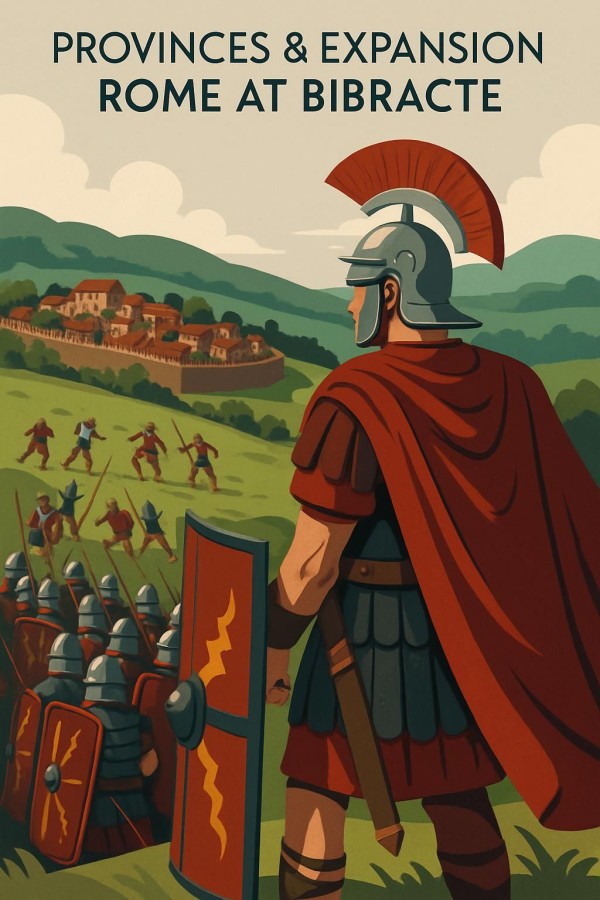
The Road to Bibracte: Republic on the Verge
The Roman Republic, in the thick of its expansionist ambitions, viewed Gaul as both menace and opportunity. By the mid-1st century BCE, with power concentrated and confidence surging in Rome’s senate, generals like Julius Caesar sought conquests beyond the established Italian heartlands. Bibracte—ancient capital of the Aedui—was thrust into the spotlight, its fortifications and position emblematic of Gallic pride and strategic possibility.
In Roman eyes, Bibracte wasn’t just a settlement; it was a linchpin to future provinces. As armies crossed the Rhône and legions followed forested ridges, the Republic stood poised to redefine its boundaries, both literally and philosophically.
Bibracte’s Gallic Majesty Meets Roman Ambition
To the Gallic tribes, Bibracte was a treasure of civilization—a high-walled oppidum bustling with traders, bronze workers, and fiercely proud warriors. It hosted intertribal councils, minted coins, and radiated local influence throughout the rolling landscapes of modern Burgundy. Yet, as Caesar chronicled his campaigns through the dense forests and valleys, the city’s role mutated from sanctuary to stage.
The epic clash at Bibracte in 58 BCE, as described in Caesar’s Commentaries on the Gallic War, became a touchstone for Roman superiority and the efficacy of the legionnaire. Rome’s victory over the Helvetii at Bibracte was less a local triumph than a continental signal: the Republic could—and would—reshape entire worlds.
Provinces in the Making: From City to Empire
Rome’s absorption of Bibracte capstoned more than a single campaign. It offered a blueprint for turning provinces into extensions of Roman order, custom, and taxation. The Gallic city’s infrastructure, repurposed by Roman architects and administrators, provided both a foothold and a proof-of-concept for provincial governance in the wider Celtic world. Temples were refashioned, markets reorganized with Roman weights, and local notables wooed into the Senate’s fold.
With Bibracte as a model, Rome honed methods of integrating conquered territories—balancing suppression and cooperation. New roads radiated outward, legionaries married local women, and Latin mingled with Gallic tongues. Provincial boundaries, set and marked, would soon stretch from the Atlantic to the Danube.
Legions and Local Rule: The Republic’s Delicate Dance
Local Gallic aristocrats, once adversaries, became essential exponents of Romanization. They mediated tribute, trade, and religious observance, weaving together old customs with the rhythms of Rome. The Senate, wary of outright revolt, offered protection and pragmatic autonomy—so long as loyalty was manifest. At Bibracte and beyond, this symbiosis produced a lasting, though uneasy, peace.
This model—military supremacy softened by political federation—became the architecture of Rome’s provincial success. Latin inscriptions and new town grids bore silent testimony to a world under transformation, sharpened by the memories of siege and negotiation at Bibracte’s gates.
Bibracte: Pivot of Continental Change
When you stand upon Mont Beuvray, where Bibracte’s ruins overlook ancient valleys, you perceive more than the stones of a bygone village. You sense the radiating shockwaves of Roman ambition. Here, conquest meant not only subjugation but synthesis: the dawn of new economic patterns, cultural codes, and political norms. The story of Bibracte is thus the story of Rome transforming from an opportunistic republic to an empire with provinces—its horizons ever expanding, its identity shaped by each land it enveloped.
Today, the archaeological echoes at Bibracte invite both awe and reflection. The Republic’s victory unleashed centuries of change, echoing in the urban mosaics of Lyon, the vineyards of Burgundy, and the very language of diplomacy. To trace Rome’s road to empire is to walk the shadowed paths first beaten by the legionaries at Bibracte—where the Republic turned the page to a provincial world, forever changed.
요약: 빕락테에서 시작된 로마의 제국화
빕락테는 고대 로마 공화정의 전환점이자, 갈리아 지역 통합 및 지방 확장 정책의 핵심 현장이었다. 군사적 승리는 곧 문화적‧행정적 융합의 단초가 되었고, 이는 로마가 지역 사회와 협력하며 통치 체계를 확립해 가는 과정을 잘 보여준다. 빕락테 이후 로마는 기존의 정복자에서 다민족 제국의 주인으로 변모하며, 그 영향은 오늘날 유럽의 역사와 문화 곳곳에 남아 있다.
댓글목록0