Tarentum & Roman Expansion

 운영자
운영자
본문
Tarentum & Roman Expansion
A rich, ornate exploration of how Tarentum shaped the ebb and flow of Roman power in southern Italy.
Introduction: A City Between Worlds
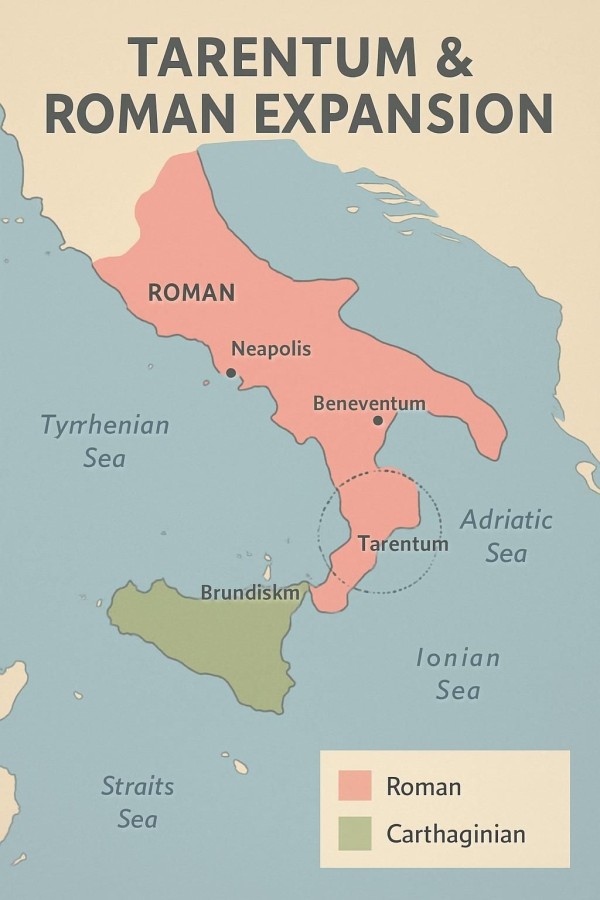
Nestled on the fertile shores of the Ionian Sea, Tarentum (modern Taranto) stood as a luminous node of Hellenic culture in southern Italy — a place where Greek architecture, maritime commerce, and martial reputation coalesced into a distinctive civic identity. This city-state was more than a mere port: it was a crucible in which conflicts between Greek colonists and the emerging powers of the peninsula were forged. In the grand theatre of Roman expansion, Tarentum's choices, alliances, and resistances would resonate far beyond its polished harbors.
To understand the later stages of Italian unification under Roman hegemony, one must first appreciate the distinctiveness of Tarentum's Greek lineage — its dialects, laws, and polis institutions — which inevitably contrasted with the agrarian and martial values of Rome and its Latin allies.
Origins and Identity
Founded by Spartan colonists in the 8th century BCE, Tarentum was part of the larger phenomenon known as Magna Graecia. With its layered Greek temples, stone-built agoras, and a seafaring aristocracy, the city cultivated an identity that prized maritime prowess and Hellenic culture. Its coinage, sculpture, and inscriptions testify to a civic pride that placed Tarentum among the most prestigious of the Greek colonies in Italy.
The tension between tradition and change was Tarentum's constant companion.
This cultural prestige made Tarentum a tempting prize for any power seeking wider influence across the Adriatic and Ionian seas.
Naval Strength and Regional Influence
Tarentum's geography granted it an enviable maritime advantage: natural harbors, deep waters, and a fleet experienced in both trade and warfare. Its shipwrights and mariners were adept at galleys that could both patrol coastal waters and contest control of key sea lanes. The city's naval capabilities allowed it to project influence along the coastline and to play a decisive role in the alliances and hostilities that embroiled southern Italy during the centuries of Roman ascendancy.
In response, Rome — whose earliest naval ambitions were modest — gradually adapted. The maritime theater that Tarentum dominated became a testing ground for Roman naval innovation and diplomacy, helping to transform Rome from a land-based hegemon into a Mediterranean power.
Conflict and the Pyrrhic Interlude
The first major rupture between Tarentum and Rome erupted in 282–272 BCE. Alarmed by Roman expansion into Lucanian and Bruttian territories, the Tarentines sought external support. Enter Pyrrhus of Epirus: a charismatic Hellenistic monarch, whose arrival in Italy (280 BCE) turned a localized contest into a spectacular confrontation. Pyrrhus' victories — costly “Pyrrhic” triumphs — demonstrated both the effectiveness of Hellenistic combined arms and the resilience of Roman military institutions.
Though Pyrrhus temporarily restored Tarentine confidence and prestige, his campaigns ultimately failed to secure a lasting coalition. The consequence was twofold: Tarentum's reliance on external champions exposed its vulnerability, and Rome learned valuable lessons in amphibious logistics, diplomatic accommodation, and the crushing attrition of a republic willing to replenish its ranks.
Pyrrhus' presence illuminated both the possibilities and perils of resisting Rome.
From Resistance to Integration
Tarentum's eventual subordination to Rome was not a simple tale of conquest; it was a protracted process of negotiation, rebellion, and accommodation. After Pyrrhus' departure, Rome consolidated its influence in southern Italy, and Tarentum oscillated between revolt and submission. During the Second Punic War, for example, the city defected to Hannibal in 212 BCE, drawn by the promise of liberation from Roman domination, only to be recaptured by the Romans later under Fabius and allied commanders.
These episodes reveal the complexity of Roman expansion: incorporation was achieved through military pressure, selective citizenship grants, municipal reorganization, and cultural assimilation. Over generations, Tarentum's elites adapted to Roman institutions, Latin language use increased, and local governance models were overlaid with Roman magistracies and law.
Civic life and economy
Tarentum sustained a thriving economy built on olive oil, wine, and maritime commerce. Its markets were vibrant crossroads where Greek and Italic goods — amphorae, textiles, metalwork — circulated. Such economic interdependence made the city both resilient and susceptible to the larger geopolitical currents that Rome navigated.
Cultural Exchange and Hybridization
Roman domination did not erase Tarentine culture overnight. Rather, a gradual syncretism emerged: local cults were integrated into Roman religious calendars, Greek art forms influenced Roman aesthetics, and bilingual elites acted as cultural brokers. In stone and inscription, one can trace a dialogue: Greek motifs persisted, while Roman legal texts and public inscriptions signalled a new administrative reality.
This hybridization mattered: it enabled Rome to govern diverse populations more effectively. Tarentum became less an outpost of continental Greece and more a Romanized Hellenic center — a testament to the Republic's ability to absorb, adapt, and reframe local identities.
Strategic Consequences for Roman Expansion
The contest over Tarentum pushed Rome to refine its strategy on multiple fronts. Maritime power became indispensable; alliances with other Greek cities and Italic tribes had to be negotiated; and the Republic's political apparatus expanded to administer distant provinces. Each step of Roman engagement with Tarentum prompted innovations in diplomacy, military organization, and economic integration that were later applied across the Mediterranean.
In a larger sense, Tarentum functions as a case study in how local resistance catalyzes imperial evolution: the city’s assertiveness compelled Rome to become more versatile, maritime-capable, and culturally dexterous.
Archaeology and Legacy
Archaeological excavations around Taranto have unearthed layers of pottery, temple foundations, and inscriptions that illuminate how the city negotiated its place within the Roman orbit. Museums display terracotta figurines and coins that narrate a visual history of cultural interchange, while submerged structures hint at the scale of maritime commerce long since silenced.
Scholars today view Tarentum not as a footnote but as a pivot: its resistance widened Rome's strategic imagination; its eventual incorporation demonstrated the Republic’s capacity for governance over heterogeneous societies.
Conclusion: The City That Shaped a Republic
Examining Tarentum's story is to witness the dialectic of local autonomy and imperial ambition. The city's Hellenic pedigree, naval strength, oscillations between alliance and defiance, and eventual accommodation into Roman structures articulate a broader narrative: Roman expansion was not a linear march but an adaptive, negotiated process shaped by the distinctive identities it encountered. Tarentum's legacy is thus twofold — a reminder of Greek vitality in Italy and a mirror reflecting the Republic's capacity to integrate complexity into lasting dominion.
Tarentum mattered because it forced Rome to become more than a city-state; it compelled Rome to reinvent itself as a Mediterranean power.
요약
타렌툼(Tarentum)은 이오니아 해안의 전략적 항구 도시로서, 그리스 식민지의 문화적 전통과 해상력으로 로마 공화국의 팽창 과정에서 중요한 역할을 담당했다. 스파르타계 식민지로 출발한 이 도시는 해상무역과 군사적 능력을 바탕으로 주변 이탈리아 지역에서 영향력을 행사했으며, 이러한 특성 때문에 로마와의 갈등과 동맹의 중심에 놓였다. 기원전 3세기 초 피로스와의 전쟁은 타렌툼의 저항 의지를 보여주었고, 그 결과 로마는 해군력과 외교술을 강화하게 되었다. 이후 타렌툼은 한동안 외세와의 연합과 반란을 반복했으나 결국 로마의 통합 체계 속으로 흡수되었다. 중요한 점은 단순한 정복이 아니라 경제적 연계, 문화적 혼종화, 행정적 재편을 통해 점진적으로 로마화되었다는 것이다. 고고학적 발굴은 타렌툼의 그리스적 전통이 완전히 사라지지 않았음을 보여주며, 오히려 로마의 지방 통치 능력과 문화적 수용성을 드러낸다. 요컨대, 타렌툼은 로마가 지중해 패권을 확장하는 과정에서 변화를 촉발한 촉매였으며, 지역적 정체성과 제국적 통합이 만나면서 새로운 역사가 형성되었음을 시사한다.
Tags: #Tarentum #RomanRepublic #MagnaGraecia #PyrrhicWar #NavalPower #Hellenistic #SecondPunicWar #Integration #CulturalHybridization #Archaeology
댓글목록1
장유빈님의 댓글