Provinces & Expansion: Uxellodunum's Role

 운영자
운영자
본문
Provinces & Expansion: Uxellodunum's Role
The ancient Mediterranean was a patchwork of ambitions, treaties and contested borders. Among the many nodes that shaped Roman projection of power, the site known today as Uxellodunum occupies a special place — at once a symbol of defiance on the periphery and a prism through which to view the expansionary impulses of the Ancient Roman republic. The story of how remote strongholds could influence metropolitan policy is a compelling counterpoint to the familiar narratives of triumphant legions and triumvirs.
In the decades when Rome was testing the limits of its republican constitution, provinces were laboratories. Administrators experimented with taxation, local elites negotiated accommodation, and military commanders adapted to new theatres of conflict. Uxellodunum, perched on a strategic hill with commanding views over river valleys, became not only a military objective but also a symbol in the rhetoric of expansion: whether it fell to diplomacy or siege affected how Rome imagined its own reach.
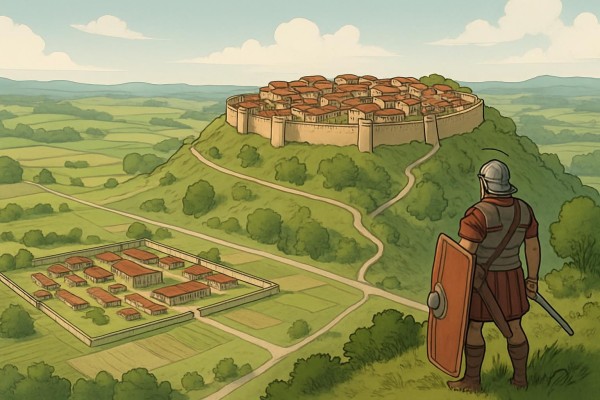
Images of the fortress and its surrounding landscape evoke the tension between natural defensibility and the growing sophistication of Roman military logistics. Supply lines, siegecraft, and the political will to commit resources were all tested when provincial resistance endured beyond a single campaigning season.
The interplay between geography and governance is therefore central to any account of provincial expansion: the topography of places like Uxellodunum could shape policy just as decisively as decrees from the Senate.
Administration, Governors, and Local Elites
As Rome extended its dominion, it relied on a delicate network of provincial officials and allied aristocrats to maintain order. Governors carried enormous authority — military, judicial and fiscal — and their personal approaches to power could either stabilize newly annexed territories or provoke recurrent rebellions. In many regions, the Roman solution was pragmatic: recognize established elites who were willing to cooperate and insert Roman soldiers strategically to deter insurgency.
Uxellodunum’s local leaders negotiated with Roman commanders, sometimes trading hostages, land rights and civic honors. The success of such arrangements depended heavily on mutual expectations. Where local custom was respected and the burden of taxation bearable, incorporation proceeded smoothly. Where Roman administration proved extractive or dismissive of local authority, resistance hardened into open conflict.
Thresholds of Faction and Civil Strife in Provincial Politics
When military commanders amassed power through repeated provincial commands, they sometimes transformed local politics into arenas for broader ambitions. Uxellodunum reveals how the margins of empire could become staging grounds for factions whose rivalries reached back to Rome itself. A garrison’s loyalty might tilt the balance between municipal tranquility and the kind of internecine warfare that reconfigured Roman institutions. Thus, the fate of a single stronghold could echo into the capital — a reminder that provinces were not passive recipients of policy but active participants in the republic’s evolving drama.
Military doctrine evolved in response to this dynamic. Siegecraft, fortification design and the logistics of provisioning long campaigns required continuous refinement. The presence of experienced legions in regions like the Gaulish hinterlands produced a two-way flow: Roman tactics adapted to terrain and tribal resistance, while local groups learned to exploit Roman constraints. A well-supplied fortress could sit at the heart of a network of insurgency or, alternatively, could cement Roman authority for generations.
Economy and Cultural Exchange
Beyond military calculus, the economic consequences of provincial integration were profound. Roads, markets and civic architecture accompanied Roman rule, stimulating local production and redistributing wealth. Uxellodunum, situated near trade corridors, felt these currents: artisans adopted Roman motifs, coinage circulated more widely, and the rhythms of life changed as new demands for goods and labor emerged. Cultural exchange was not a one-way imposition; Roman citizens too encountered foreign customs, foods and beliefs that would gradually alter attitudes back home.
Provincial taxation funded infrastructure and legions, but it also produced grievances when levies were perceived as disproportionate or corruptly administered. Such fiscal stress could tip a fragile equilibrium toward conflict, particularly when local leaders sensed the opportunity to resist or when ambitious commanders sought to extract wealth to secure their own power bases.
The rhetorical use of provincial victories was another instrument of Roman expansion. Celebratory monuments, public speeches and coinage commemorated sieges and incorporations, shaping public memory and legitimizing further campaigns. A subdued fortress became not just a military achievement but a narrative resource — a proof point in the republic’s story of order and civilization.
Scholarship on Uxellodunum and similar sites reminds us that provinces were crucibles of innovation and contestation. Archaeology offers material clues — fortifications, import wares, and destroyed layers — while ancient narratives supply interpretive frames. Together they show a complex interplay of coercion and accommodation, where negotiation mattered as much as force, and where local agency could redirect the course of imperial ambition.
Memory, Myth and the Republic’s Legacy
The way Romans remembered provincial events shaped later policy. Uxellodunum was not only a place of historical fact; it became a rhetorical instrument. Poets, historians and politicians mined episodes of provincial resistance and victory to make points about virtue, discipline and the costs of expansion. Memory often simplified nuance — valorized conquest or lamented trespass — but those simplifications mattered, directing subsequent generations toward certain paths of action.
In modern study, the intersection of material evidence and literary testimony creates a richer, if more contested, picture. Interpretations shift as new finds emerge and as historians reframe questions about empire, sovereignty and the role of the military in politics. Uxellodunum remains a case study in how peripheries influence centers: a tactical problem that became a political question and then a cultural memory.
For readers who want more, further reading and source material illuminate the broader context: archaeological reports, regional surveys and critical editions of contemporary accounts. One convenient starting point is the Wikipedia entry on Uxellodunum, which aggregates essential references: source.
Tags: Ancient_Roman_republic, Uxellodunum, provincial_governance, military_history, siegecraft, archaeology, cultural_exchange, fiscal_policy, memory, civil_strife
The examination of Uxellodunum within the broader sweep of the Ancient Roman republic encourages us to see provinces not as distant backdrops but as active forces shaping imperial destiny. Each campaign, treaty and negotiation was a thread in a larger loom that produced institutions and myths alike.
In the end, whether through the blunt instrument of arms or the subtler exercises of administration, the republic’s expansion was negotiated in places like Uxellodunum — contested nodes where the republic’s principles were tested against local realities, producing outcomes that reverberated across decades.
요약: Uxellodunum은 로마 공화국의 영토 확장 과정에서 군사적·행정적·문화적 교차로로 기능했으며, 지방의 저항과 협상이 중앙의 정책과 제도에 직접적인 영향을 미쳤다. 지방의 지형과 엘리트 간 협력, 세금과 군사 주둔은 내전의 문턱에서 정치적 균형을 흔들 수 있었고, 결국 이러한 지역적 사건들이 공화국의 기억과 정체성 형성에 기여했다.
댓글목록0