Carteia: Gateway, Colony, and the Making of Roman Hispania

 운영자
운영자
본문
A city at the edge of two worlds
Carteia sits, in archaeological terms, where the Mediterranean leans toward the Atlantic: the head of the Bay of Gibraltar, overlooking what travelers and traders of antiquity recognised as a vital maritime choke point. Its recorded life begins with Phoenician mariners and a name cognate with other colonial ports — Kʿrt, "the city" — and blossoms into a Roman municipal hub that mattered far beyond its modest footprint.
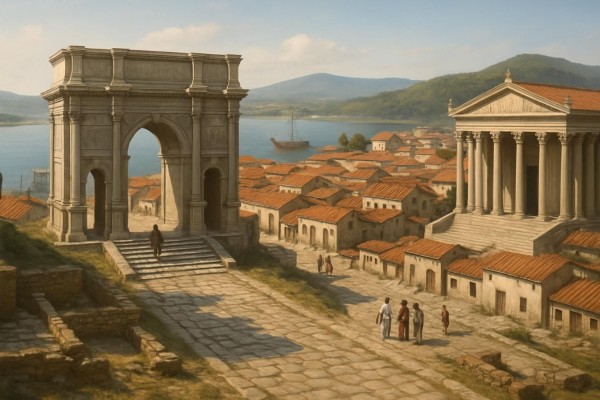
Think of Carteia as a litmus test for Rome's provincial policy: here you can see early patterns of economic extraction, cultural hybridization, and the legal tinkering that would come to define Roman expansion on Iberian soil.
In short: Carteia was not merely a port — it was an experiment in turning outsiders into stakeholders.
"A Phoenician foundation that became Rome's first Latin colony outside Italy" — a phrase that captures both ancient continuity and Republican innovation.
Origins and strategic geography
Ancient authors place Carteia among the earliest coastal settlements in southern Hispania. Strabo and later compilers attribute a Phoenician foundation; archaeological remains corroborate long-term occupation through Phoenician, Carthaginian and Roman phases. Its hinterland offered timber, metals and the famous murex snails for purple dye — commodities that made ports like Carteia indispensable to Mediterranean trade networks.
Maritime control here was not an abstract military advantage. Whoever held Carteia could influence routes into the Guadalquivir basin, monitor shipping through the southern Iberian littoral, and stage naval operations into the western Mediterranean.
Quick point: location = leverage. Carteia's geography explains why Carthage, Rome, and later local powers valued it across centuries.
Carteia in war and diplomacy
The Second Punic War and the turbulent decades that followed placed Carteia onto military maps. Naval engagements occurred nearby, and the town repeatedly figured in the ebb and flow between Carthaginian and Roman fleets. In 206 BC, a naval clash near Carteia helped consolidate Roman maritime supremacy in the region.
But military events are only half the story. The political choice Rome made about Carteia in 171 BC reveals much about Republican priorities.
The grant that mattered: Carteia was assigned to a delegation of some 4,000 men of mixed Roman and local parentage — a legal and diplomatic innovation that created the Colonia Libertinorum Carteia and a precedent for Roman enfranchisement in the provinces.
This was not full Roman citizenship as known in Italy, but Latin rights — a middle status that allowed intermarriage with citizens and commercial privileges. It was a pragmatic solution: reward service, stabilize a borderland, and bind local elites to Rome without an instant flood of Italian legal norms.
Why did Rome favour this intermediate status? One answer: it reduced friction. By granting local notables a stake in the Roman system, the Republic could secure loyalty while keeping military and fiscal controls manageable.
Economy and urban form
Under Roman rule Carteia matured into a small but economically active city. Archaeology has revealed amphora kilns, garum production evidence, baths, temples and a forum — signs of a port integrated into long-distance trade and regional commodity networks. Excavations show local amphora types used for wine and fish-sauce exports, and a mint once operated in town.
- Garum and salted fish processing were premium export industries.
- Local amphorae and kilns indicate specialized ceramic production.
- Public architecture — baths, forum, temple podiums — reflect Roman civic investment.
These material traces help us imagine an active coastal marketplace where Iberian produce and Roman capital met. But the archaeological record also speaks of continuity: Carthaginian masonry and Phoenician layers underlie many Roman structures.
A small city, yes — but a concentrated one, where trade, law, and identity were negotiated daily.
Rediscovery, modern stewardship, and contested landscapes
Carteia's ruins were noted by early modern antiquarians and later linked definitively to the ancient site near San Roque. Excavations across the nineteenth and twentieth centuries uncovered pavements, statuary fragments, and the layout of a Roman forum. Today the site and its finds are presented at the Museo Municipal de San Roque, and the archaeological enclave is managed by regional authorities.
Yet Carteia faces modern pressures: industrial development, urban encroachment and the challenges of conserving an exposed coastal site. Preservation here is as much about public policy and tourism strategy as it is about potsherds.
Watchpoint: heritage protection at Carteia is uneven — the main urban core is accessible and curated, but surrounding necropoleis and ancillary areas have been lost to development in past centuries.
Local initiatives now blend exhibition, educational programming and digital outreach — recent projects include immersive displays that reconnect artifacts to their social contexts in Carteia's Roman heyday.
Carteia as a case study in provincialization
For historians of the Republic, Carteia is valuable because it condenses several themes: the negotiation of citizenship, the role of colonial foundations in regional control, and the interplay between military strategy and commercial interest. The 171 BC settlement of the 4,000 is a concrete illustration of Rome inventing legal workarounds to manage cultural complexity.
The lesson for broader Roman provincial studies is twofold: first, incorporation was gradual and creative; second, smaller centers like Carteia were often where policy was tested before being scaled up across provinces.
Short question to the reader: when you think of Roman expansion, do you picture legions and sieges — or quieter institutions that reshaped lives, law, and trade?
Visiting Carteia today
The archaeological site near San Roque is open to visitors and the town's museum curates many of Carteia's finds; local guides can walk you through the forum remains and point out the sequence of Phoenician, Carthaginian and Roman layers. For practical visitor information and current openings, the municipal pages provide schedules and contact details.
If you go, look for three things: the temple podium, evidence of industrial amphora production, and the placement of the port relative to the town — those alignments tell the long economic story in plain sight.
Field-tip: combine the site visit with the Museo Municipal de San Roque to see amphorae and sculptural fragments that help reconstruct daily life at Carteia.
Final thoughts — why Carteia still matters
Carteia is compact but historically dense: it exemplifies how Rome expanded not only by force but by legal creativity and economic integration. The town's trajectory from Phoenician entrepôt to Roman colonia illuminates the incremental processes that turned disparate Mediterranean communities into a Roman world.
Emphasis: Carteia shows us that empire is built at the margins — in small courts, on amphora-laden quays, and through laws that reshaped identity as much as territory.
For readers interested in digging deeper, authoritative overviews and recent reporting are available from scholarly summaries and local heritage pages; for a lively journalistic take on the 171 BC settlement and its afterlife, contemporary articles revisit how Carteia's story resonates with modern debates on belonging and citizenship.
A short invitation: next time you read about Roman provinces, pause — and imagine the small port-city where Rome first tried a new kind of inclusion.
Further reading and resources are embedded as links in the text above for convenience. Below are a few highlighted sources referenced in this piece.
Key sources cited in this article:
- Carteia (overview and archaeological notes).
- El País — the story of the 4,000 and modern Carteia.
- Naval engagements near Carteia (Second Punic War).
- Ayuntamiento de San Roque — site and museum information.
- Junta de Andalucía — Carteia archaeological enclave.
Closing note: Carteia rewards both the wandering antiquarian and the focused scholar — it is a small site with disproportionately large lessons about integration, law, and the everyday mechanics of empire.
댓글목록0