Mutina and Roman Expansion

 운영자
운영자
본문
Mutina and Roman Expansion
An exploration of Mutina's role in the Roman Republic's consolidation of northern Italy and the political flashpoints that made it famous.
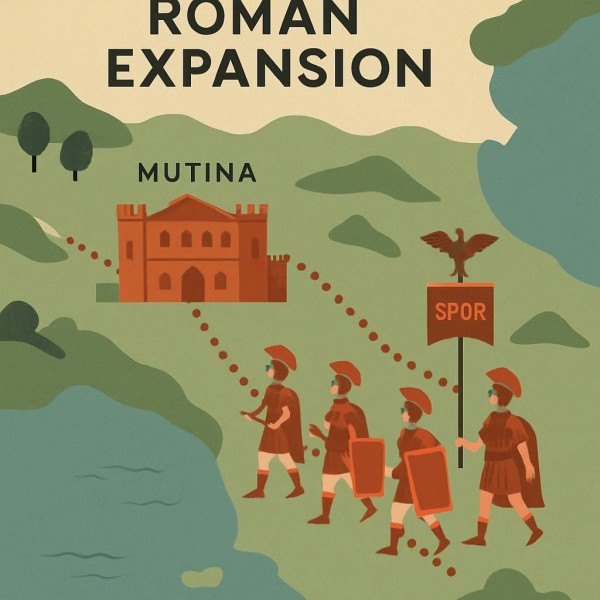
Introduction: A City at the Crossroads
Mutina, known today as Modena, sits on the fertile plain of the Po Valley and emerged as a crucial node in the expansion of the Roman state into the lands north of the Apennines. Its location along the Via Aemilia and its proximity to important river crossings made Mutina both a commercial hub and a strategic military objective. This essay examines how Mutina exemplifies wider patterns of Roman expansion during the Republican era — processes of colonization, infrastructure development, municipal incorporation, and violent contestation during periods of civil conflict.
Geography, Roads, and Roman Strategy
The Roman Republic's growth was never accidental; it was managed through planning and the control of movement. Mutina's importance starts with its geography: located on relatively high ground within the Po plain, it offered easier transit and defense compared with the marshy lowlands that surrounded some sections of the plain. The construction and maintenance of roads such as the Via Aemilia and branch routes connected Mutina to Ariminum (Rimini), Parma, and Cremona, turning the city into a logistical node. For Roman planners, roads meant taxation, troop movement, and cultural integration. In this sense, Mutina illustrates a typical Roman strategy: secure a network of towns and roads, assign colonies or veteran settlements, and integrate local elites into a Roman civic order.
Military vantage: Mutina's elevated terrain offered an advantage when armies moved through the Po valley. The city's fortifications in various periods, both pre-Roman and Roman, reflect a long-standing awareness of the defensive value of its position.
Colonization and Romanization
One of the Republic's main instruments for controlling newly acquired territories was colonization. Mutina received Latin and Roman settlers at different points, and through this infusion of population, Roman law, language, and social customs spread across the region. Municipal status and the granting of civitas or Latin rights gradually transformed local political structures. These processes were not uniform: the pace of Romanization depended on economic incentives, elite collaboration, and the presence of magistrates and veterans who embodied Roman institutions.
Archaeological remains — pottery types, inscriptions, and urban planning traces — reveal how Mutina's public spaces and roads were reorganized to fit Roman administrative expectations. Public buildings, temples, and forums signaled the extension of Roman civic identity into the north.
Political Flashpoints: Mutina and the Republic's Turmoil
Though its growth owes much to steady administrative processes, Mutina also became a stage for violent politics. In the late Republic, cities like Mutina were not merely passive recipients of policies; they were contested spaces where generals, senators, and local magnates clashed for control. The city's strategic value drew attention during civil wars and campaigns whenever a faction needed a base north of the Apennines. Such episodes illuminate how expansion and internal politics were intimately related: territorial control created power, and power sought territory as its instrument.
Mutina's role in these confrontations exemplifies the way Roman expansion sometimes proceeded through force and diplomacy in alternating measures. Control of the city could mean the control of grain routes, veteran settlements, and political legitimacy in the region.
Note: When historians look at Mutina, they examine both material culture and literary accounts. The literary sources — annalistic fragments, epitomes, and later historians — often emphasize the city's military episodes, while archaeology provides a complementary view of daily life, trade, and civic evolution.
Economic Life and the Agrarian Basis of Power
The Republic's expansion cannot be understood without acknowledging the centrality of agriculture. Mutina thrived because it controlled productive land in the Po valley — fertile fields that produced grain, oil, and other staples. Agricultural surplus financed political power in Rome: land allocated to veterans created new landowners loyal to their benefactors and stimulated local economies through market exchanges. The economic transformation of Mutina included the assimilation of local landholding patterns into Roman modes of ownership and management.
Markets, crafts, and river trade transformed Mutina from a small settlement into a thriving municipium where local artisans traded with distant consumers connected by the Roman road system.
Institutional Integration and Local Elites
Political integration involved co-opting local elites into Roman frameworks. Municipal councils, magistrates, and inscriptional evidence show how leading families in Mutina adopted Roman titulature and participated in civic life modeled on Roman examples. These elites acted as intermediaries, helping to implement Roman taxes, public works, and cultural programs, while preserving aspects of local prestige. This accommodationist model of expansion allowed Rome to govern a wide diversity of peoples with relatively few direct administrators.
In return, local elites gained access to Roman patronage networks and had opportunities for social advancement by sponsoring public buildings, games, or inscriptions that tied their names to Rome's expanding identity.
Military Infrastructure and Fortification Patterns
Military presence left enduring marks on Mutina's urban fabric. Temporary camps, permanent fortifications, and roads designed for legions were part of how the Republic secured its frontiers. The pattern is familiar across Roman Italy: forts near key crossings, roads that doubled as supply lines, and towns that served as logistical hubs in campaigns. When legions established winter quarters or when magistrates mustered troops, Mutina's facilities and hinterland proved essential.
The synergy between military needs and civic development often translated into public investments: roads were repaired, bridges consolidated, and marketplaces expanded to meet the demands of soldiers and administrators.
Cultural Syncretism and Identity Formation
The cultural landscape of Mutina reveals syncretic processes. Local Italic traditions overlapped with Roman religious practices; temples might combine architectural features, and religious dedications sometimes linked Latin and local deities. Language shift was gradual, with bilingual inscriptions appearing in transitional centuries. Through schools, legal practices, and public ceremonies, Roman identity spread while local customs persisted in adapted forms.
This kind of cultural negotiation was typical of the Republic's expansion: instead of erasing local identities outright, Romanization often produced hybrid cultures that preserved continuity while aligning political loyalty to Rome.
Case Study: A Moment of Crisis and Change
Consider a crisis moment when competing generals vied for control of the north. When armies converged on Mutina, the city's fate determined who controlled the surrounding region. In such crises, the routine mechanisms of expansion — roads, elites, land allotments — intersected with raw force. A successful defense or capture of Mutina could shift alliances, redirect supplies, and change the political landscape. Thus, studying a single engagement or siege prompts a broader reflection on how expansion and internal competition were inseparable in the Roman Republic.
Archaeology and the Longue Durée
Archaeological evidence from Mutina contributes to a longue durée perspective on Roman expansion. Stratigraphy shows phases of urban development, shifts in housing styles, and changes in material culture. Inscriptions, amphorae stamps, and coin finds point to commercial connections across the Italian peninsula and the Mediterranean. When integrated with literary sources, these remains deliver a fuller picture of how a city like Mutina transitioned from a regional center to a fully integrated municipal partner within the Republic.
The longue durée encourages us to see expansion as a process measured in generations, not only decisive battles. Mutina's archaeological record attests to the cumulative effects of roads, colonists, local collaboration, and intermittent violence.
Lessons from Mutina for Understanding Roman Expansion
What does Mutina teach us about expansion under the Republic? First, the strategic placement of towns and roads created durable networks of control. Second, colonization and municipal incorporation were key tools for embedding Roman law and culture. Third, the cooptation of local elites smoothed governance and created stakeholders in the Roman project. Finally, periodic military confrontations reveal that expansion was contested and sometimes followed by renegotiation of power.
Mutina is, therefore, both representative and unique: representative in its trajectory from regional settlement to integrated municipium; unique in its specific political episodes and the particular alignments of local actors.
Reflections on Sources and Interpretations
Scholarship on Mutina draws on a mélange of sources. Literary accounts can be partisan, often written by Romans with their own political agendas; inscriptions and material culture offer corrective detail but require careful interpretation. Modern historians combine these strands, using comparative studies of other cities to test hypotheses about Romanization, veteran settlement, and economic change. Interdisciplinary approaches — incorporating epigraphy, numismatics, and landscape archaeology — provide the most robust reconstructions.
Ongoing excavations and digital mapping projects continue to refine our understanding, showing that interpretations remain dynamic and responsive to new data.
요약: 이 글은 북부 이탈리아 평원에 자리한 무티나(Mutina, 현대의 모데나)가 공화정 로마의 확장 과정에서 어떻게 전략적 요충지이자 경제적·정치적 통합의 장으로 기능했는지를 살펴본다. 도로망과 식민 정책, 지방 엘리트의 협력, 군사적 중요성, 고고학적 자료의 기여를 통해 무티나는 로마의 영토 확장이 세대에 걸친 점진적 과정임을 보여준다. 또한 분쟁과 내전의 시기에 무티나가 정치적 향방을 좌우하는 결정적 무대가 되었음을 강조한다.
댓글목록2
오유빈님의 댓글
김정희님의 댓글