Ariminum: Gateway to Roman Expansion and Provinces

 운영자
운영자
본문
Ariminum: Gateway to Roman Expansion and Provinces
Discover how the city of Ariminum unlocked legacies of military, political, and economic prowess in the heart of the Republic’s rise.
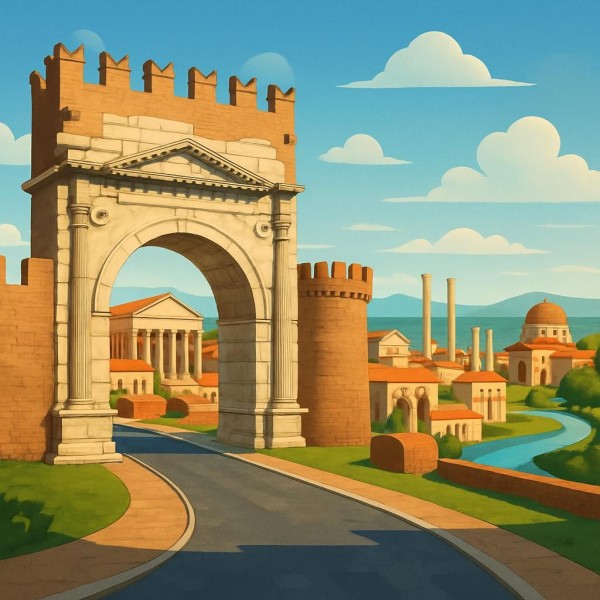
The Strategic Heartbeat of the Italian Peninsula
In the storied chapter of Rome’s evolution, few cities have held such profound strategic and symbolic relevance as Ariminum. Founded at the crossroads of ancient Italy’s tumultuous north and Rome’s burgeoning south, Ariminum was more than a mere settlement—it became a crucial linchpin in the Republic’s grand narrative of conquest, integration, and regional control. With its established position on the Adriatic coast, where the rivers Marecchia (ancient Ariminus) and Ausa meet the sea, it naturally evolved as a bridge between Italic tribes, Etruscan, and Greek spheres of influence.
The settlement of Ariminum in 268 BCE by Rome's decision, during a pivotal period of military expansion, was not coincidental. Its enduring port and fertile plains made it a vital staging ground for campaigns into Cisalpine Gaul and the broader Po Valley—regions teeming with both opportunity and danger for an aspiring Mediterranean superpower.
Porta of the North: Military & Mercantile Power
Ariminum stood astride the Via Flaminia—Rome’s arterial road which connected the city directly southwards to the capital itself. This vast road construction project, completed in 220 BCE under Gaius Flaminius, transformed Ariminum into the natural terminus for traffic, ideas, and resources coursing through the Republic. Another crucial road, the Via Aemilia (constructed in 187 BCE), extended northwest from Ariminum to Placentia (Piacenza), allowing for swift military movements and deeper economic integration across the Po plain.
As a busy harbor city, Ariminum hosted a vibrant population—Italians, Etruscans, Greeks, and later Gauls and Romans themselves. The city's dual identity as both a naval outpost and agricultural center fostered the transmission of Roman customs, coinage, language, and law into unfamiliar provinces. The capacious storage warehouses, bustling marketplaces, and religious fora bear witness even today to cross-cultural exchange at an unprecedented scale.
Political Legacies: From Sulla to Caesar
Ariminum’s identity is inseparable from the tumultuous politics that alternated between compromise and confrontation. After the Social War (91–88 BCE), when the Republic extended citizenship to the Italian allies, Ariminum emerged as the symbol of a new Roman Italy—its forum became a microcosm of democracy, debate, and decision-making.
But perhaps the city’s greatest moment in political theater came during the fateful winter of 49 BCE. As tensions mounted between Gaius Julius Caesar and the Senate, it was at Ariminum that Caesar chose to defiantly cross the river Rubicon with his loyal legions—a dramatic act of insurrectio that ignited civil war and ultimately dismantled the old order. The phrase “Alea iacta est”—the die is cast—echoed from Ariminum’s stone streets and into the timeless memory of history.
Urbanization, Infrastructure, and Social Fabric
Beyond its military and political legacies, Ariminum stands as a marvel of Roman urban planning. The city’s original colonia layout incorporated orthogonal streets, central fora, grand basilicas, temples to Jupiter and Minerva, and two remarkable Roman bridges. The Ponte di Tiberio—constructed during the reign of Augustus and Tiberius—remains a testament to early Roman engineering, gracefully spanning the Marecchia for nearly two millennia.
Water management, a hallmark of Roman civilization, was evident in Ariminum’s complex aqueduct network. Public baths, amphitheaters, and monumental city gates were woven into the lives of citizens and visitors alike, serving not merely as infrastructure but as symbols of Roman identity and collective pride. Socially, Ariminum fostered a sense of cosmopolitan civic life: annual festivals brought together military officers, priests, merchants, and freedmen in a delicate but enduring tapestry of shared values and ambitions.
Ariminum and Provincial Administration
As Rome’s reach expanded beyond the Italian heartland, Ariminum swiftly adapted to new realities. The city served as a vital administrative hub—first for the Ager Gallicus, then as the entry point to provinces beyond the Rubicon. Military governors and financial procurators spreading out from Ariminum brought Roman law, census, cults, and taxation, setting the tone for provincial integration on the Republic’s northern frontiers.
Ariminum also played a pivotal role during times of unrest. As the Gallic and Germanic threats ebbed and flowed, the city defended against incursions while also encouraging settlement—retired legionaries, colonists, and even captured hostages. In the process, Ariminum cultivated traditions of loyalty and a distinctively provincial style, balancing the gravitas of Rome with the unique voices of new citizens and communities.
Religious Mosaic and Cultural Flourishing
Religion thrived amid Ariminum’s competing influences. Early cults to Jupiter, Juno, and Minerva mingled with Etruscan and italic deities, and the arrival of Roman magistrates brought both innovation and orthodoxy. The construction of monumental temples accompanied the integration of new rites and festivals—including Olympian games, Saturnalian feasts, and later, the Imperial cult that spread throughout northern Italy.
Ariminum’s status as a melting pot resulted in vibrant artistic production: intricate mosaics, locally minted coins featuring both republican and imperial symbols, and inscriptions that revealed both the pride of citizenship and the cosmopolitan aspirations of its inhabitants. The city supported literary societies and theaters—one even rivaling those in neighboring Ravenna and Bononia.
Decline, Survival, and Lasting Legacy
Despite its glories, Ariminum could not escape the turbulence of late antiquity. Invasions by Goths and Lombards, economic realignments, and the eventual waning of the Western Empire left scars on the city’s famed walls and forum. Yet, unlike many other Roman colonies, Ariminum survived as a vibrant medieval commune—eventually becoming part of the Papal States and bequeathing its architectural and legal traditions to generations yet unborn. Even today, the name “Rimini” conjures echoes of that ancient past, its museums and monuments standing as reminders of the Republic’s unyielding ambition and ingenuity.
As a gateway, Ariminum was always more than a city: it was the Republic in microcosm, where strategy, ideology, and humanity intertwined—laying the foundations for a truly Roman world.
댓글목록1
양민우님의 댓글