Aquitania and Roman Expansion

 운영자
운영자
본문
Aquitania and Roman Expansion
An evocative exploration of culture, conquest, and provincial transformation in the late Republic.
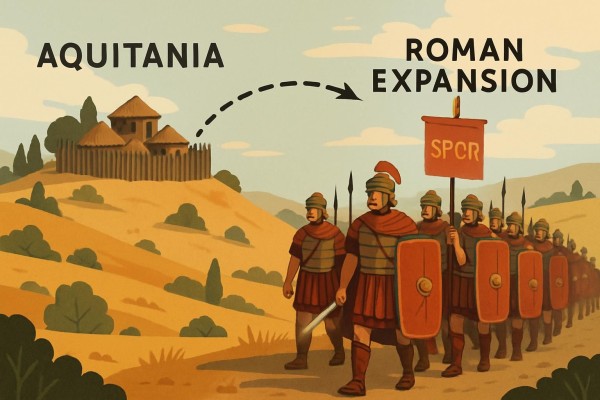
Aquitania — the word conjures rivers and uplands, mixed languages and shifting borders. In the late Roman Republic, this southwestern region of Gaul occupied a strategic place on the map of Mediterranean expansion. It represented a threshold: where Iberian influences met Celtic cultures, where river corridors like the Garonne and Dordogne linked the Atlantic to inland trade routes, and where Rome's appetite for stability and resources met local resilience. This post surveys the complex encounter between Roman institutions and Aquitanian societies, with emphasis on military campaigns, administrative integration, economic networks, and long-term cultural legacies.
Geography and People. The inhabitants were diverse: tribes collectively remembered in Roman sources as the Aquitani, who maintained distinct languages and customs that set them apart from other Gallic groups. Scholars note linguistic affinities between Aquitanian names and proto-Basque formations, hinting at ancient substrate populations that predated large-scale Celtic migrations. Topography shaped society: fertile floodplains favored mixed agriculture, uplands hosted pastoralism, and estuarine coasts supported harbors and seasonal trade.
The Republic's expansion into Gaul produced a cascade of interactions. Military action often preceded administrative reorganization. The Roman approach combined force and accommodation: decisive campaigns under commanders of the late Republic opened territories, while veteran colonization, treaties with client elites, and the establishment of roads consolidated control. In Aquitania specifically, the period of active Roman engagement culminated during the Gallic Wars of the 1st century BCE — episodes that altered political geography and accelerated integration.
Military Campaigns and the Road to Provincehood
Roman legions advanced into Aquitania with a combination of hard pressure and negotiated settlements. Campaigns targeted fortified oppida and river strongholds, aiming to break the capacity of tribal coalitions to resist. Once a military foothold was secured, the Romans invested in logistics: roads, bridges, and small garrisons that ensured the swift movement of troops and the enforcement of tax obligations. These physical links mattered as much as political decrees; roads converted contested landscapes into corridors of administration and commerce.
The military imprint became a lasting framework for governance.
Once annexed, areas of Aquitania were gradually reorganized within Roman provincial structures. Land surveys, cadastral records, and the granting of municipia or coloniae promoted civic life modeled on Roman institutions. Local elites who collaborated with Rome gained privileges — magistracies, tax exemptions, and the right to Roman citizenship for civic units — while the broader peasantry experienced new obligations and opportunities. Roman law, language, and urban planning introduced an administrative vocabulary that reshaped everyday life.
"Integration was seldom one-way; it produced hybrid identities, bilingual inscriptions, and a mosaic of practices blending Roman techniques with local customs."
Economy and trade were decisive agents of change. Aquitania exported cereals, cattle, salted fish, timber, and luxury items such as refined pottery. Rivers enabled bulk movement of goods, while new roads allowed finer distribution inland. The presence of markets, or fora, stimulated artisanal production and monetization of local economies. Roman coinage circulated steadily, and the fiscal demands of the state encouraged market integration and the monetization of taxes.
Urbanism and Material Culture
Urban centers emerged as focal points for Roman civil life. Some towns were newly founded as colonies for veterans, others grew out of existing oppida that adopted Roman plans: grid streets, forums, baths, and temples. Archaeology reveals ceramics, roof tiles stamped with legionary marks, and stylized mosaics that testify to a growing Roman material culture. Yet, in rural areas, traditional forms persisted: roundhouses, localized pottery styles, and continuity in agricultural techniques demonstrate selective adoption of Roman traits.
Art, architecture, and everyday objects thus reflect a negotiation between imposed forms and enduring traditions.
Religion was another axis of synthesis. Inscriptions and sanctuaries reveal a fusion of Roman gods with indigenous deities. Sacred groves continued to be venerated, while temples to classical gods appeared in urban settings. Rituals involving votive offerings were common, and the epigraphic record shows bilingual dedications that illuminate the coexistence of languages and devotional practices.
Points of Tension
- Taxation and requisitioning of supplies.
- Resistance to conscription and legionary levies.
- Conflicts over land rights and veteran settlements.
Instruments of Integration
- Municipal institutions and Roman law.
- Road networks and logistical supply chains.
- Commerce, coinage, and taxation systems.
One should not conceive of Roman expansion as pure erasure. In Aquitania, syncretism produced a layered sense of belonging. Roman magistrates spoke Latin and inscribed dedications, yet local languages survived in private and communal life. Marriage alliances bridged social strata, local chieftains appropriated Roman honors, and veteran colonies introduced new agricultural techniques that coexisted with longstanding methods. Over generations, identities reconfigured around hybrid civic frameworks.
Long-Term Legacy
The Roman presence set in motion institutional, economic, and infrastructural templates that endured beyond the fall of imperial authority. Roads remained arteries for trade, urban centers evolved into medieval towns, and legal frameworks influenced later governance. Linguistic traces persisted: place-names, hydronyms, and personal names provide a palimpsest of cultural succession. In many ways, Aquitania's history after Roman arrival is a testimony to adaptation — a provincial story that fed into wider European trajectories.
Modern archaeological projects continue to reveal subtleties. Field surveys, aerial photography, and material analyses refine our understanding of settlement patterns, agricultural intensity, and the rhythm of daily life. Epigraphic evidence unlocks administrative forms and social networks; isotopic studies of human remains hint at mobility and diet. Together, these methods form a multidisciplinary narrative that rehumanizes a region often reduced to maps and campaigns.
Conclusion: Aquitania's absorption into Rome demonstrates both the coercive capacities of Republican expansion and the resiliency of local structures. The region became a crossroads of commerce, administration, and cultural exchange; its story illuminates the mechanics of provincial transformation across the Roman world.
For readers who cherish archaeology, ancient history, and the long arc of cultural exchange, Aquitania offers a layered story that rewards long attention.
요약 (Korean)
이 글은 기원전 말 로마의 서진 가운데 아키타니아 지역이 어떻게 군사적, 행정적, 경제적으로 통합되었는지를 다룹니다. 강과 도로를 중심으로 한 물류망의 확대, 군사 주둔과 정착민 정책, 지방 귀족과의 협상 등을 통해 로마식 제도와 지역적 전통이 결합되었고, 이로 인해 도시화와 상업의 발달, 종교와 문화의 혼성화가 일어났습니다. 고고학적 발견과 문헌 증거는 이 지역의 점진적 로마화가 단순한 동화가 아니라 상호적 적응의 과정이었음을 보여줍니다.
Tags
댓글목록2
양준서님의 댓글
김민수님의 댓글